Feeds:
Posts
Comments

So its over

The Romance Writers’ Australia Conference is over. It is kind of sad but also a relief because of the fatigue. I’m grateful for what I have learned and the inspiration I derived from those around me. A few little things I forgot last post. At the opening of the conference, the RWA celebrates the first sales of its members. In all 31 tradition and e-published authors were called up. I thought this was wonderful. Your first sale (I haven’t had my first novel sale) must be the most exquisite moment and to have your peers recognise it for those authors, was very moving for me. Well done RWA!

I also gathered that the RWA does a lot of things to help emerging romance writers through its competitions, mentorships and writing intensives. On a personal level, I found everyone I met was welcoming and interesting in sharing a few words with me. It was very nice. By the way, I sent my membership form off before I left for the conference as I was already convinced that it was right for me.

Last night I didn’t attend the awards, but I did write 4000 words after my blog post. It was a bit of a breakthrough for me because I haven’t written that much in one go for over 7 months. All because I was inspired to be more focussed and to put my eye back on the main game. (Note I am currently writing this blog on the train).

One of the funny anecdotes from day one was the difference in Australian English usage and USA English usage. Almost all romance is published in the USA, so writers have to be aware of that if they are aiming for that market. Anyway, one of the writers said on her panel that her novel ended with the final line. “You sanctimonious bastard.” It was changed by the USA editor to “You sanctimonious asshole.” This made us all laugh. Apparently ‘bastard’ is very strong language and a terrible thing to say in the USA so it was changed. However, I think ‘asshole’ or ‘arsehole’ is much stronger and nastier. Judging by the laughter, I think others felt the same.

So today I attended a very interesting session on Georgian and Regency cloths. The underlying message is that silk was not worn as underwear and that the dresses that survive today in museums aren’t the normal every day wear of people in those times. Only the best dresses survived, like wedding dresses, ball gowns, formal wear. So Lizzie wouldn’t be walking around Pemberley in a muslin gown during the winter. The presenter had been working on a thesis on textiles and so it was very interesting as she walked us through the changes in how textiles were made and how some types of cloth was no longer made and they were lost after a while, ie they no longer exist except in sample books. I thought it was a great presentation, which confirmed that most of my Victorian-themed MS has the right detail, but also inspired me for another idea for a Regency romance that has been on my mind for about 10 years.

I went to a session on sub-characters and that was instructive too. The main lesson for me, don’t let your sub-characters (secondary) take over and make your hero look bad. Sometimes we fall in love with our secondary characters, but for a romance they must be focussed on the hero and the heroine. Actually I think it is the same for other genres too.

By the way, most of the publishers said rural romance is hot at the moment and Australian rural romance is selling well here.

The other fun session today was the speed dating panel with publishers and agents. It was hilarious, at times, and also fun to hear agents and publishers asking for manuscripts and even being funny about it. The Harlequin representative said come on a publishing date with us because we are desperate. Then she quoted stats that said they took 7 out of 10 of the submissions in the last three months. They also did a presentation later in the day to explain that Harlequin don’t only publish romance but a range of commercial fiction and even non-fiction. So check out their sites. Also, they have launched the digital first imprint Harlequin Escape. This afternoon, Sarah Fairhall said that Penguin’s digital first imprint, Destiny, would be publishing in print too, next year. So what an opportunity. A new imprint looking for Australian voices. I’d say flirt with your Destiny.

So it is over and I’m inspired. Inspired not only to write, but to write a range of things and to be more focussed on the main game and to treat writing as a business, a serious business. I love romance as well as science fiction, fantasy and horror but that doesn’t mean I can’t explore all of them. Also I need to give myself permission to write romance and pursue a career in romance writing.

The next RWA conference will be in Freemantle. I’m seriously considering it. I hope I am one of the authors receiving my first sale ribbon.

Today was the official start of the program, although things have been going since we arrived. Nicole attended the published author day, which is focused on professional development targeted at published writers.

Friday we did our pitch sessions, after spending the morning drafting pitches. Carole George couldn’t make the sessions so we pitched to the lovely Sarah Fairhall. It was a bit nerve-wracking because the appointments were running behind and waiting there felt like I was waiting to see the school principal. It was that sort of thing. I think the pitch session went very well, though I think my pitch needs more work. You see the novel I’m pitching I hadn’t really thought of as romance, even though I know quite well that that is the main thrust of it. The traditional romance tropes are there, but because it is a meld of steampunk and gothic horror, I had been targeting it to spec fic  genre rather than romance.

Also, I’m not across how to market the romance side, or I wasn’t until I came here to the conference. Now it is a matter of rethinking how I think about this work. Even with the paranormal romance I’m writing, I have to think about the core elements so I can work out a pitch. I saw a woman today recite her pitch perfectly. I was thinking, my goodness they really mean you have to learn it off by heart and be ready. So they’re not kidding. I have to take this writing gig more seriously than I do now.

So I sent my ms off. Apparently, people don’t always send their ms off when requested so Nicole said we had to make sure we did.

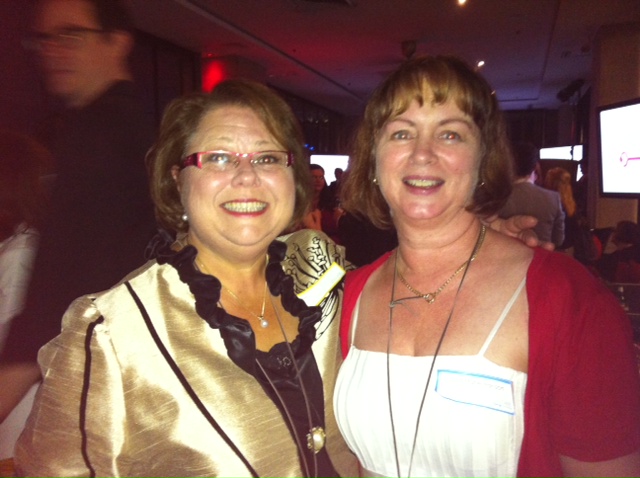
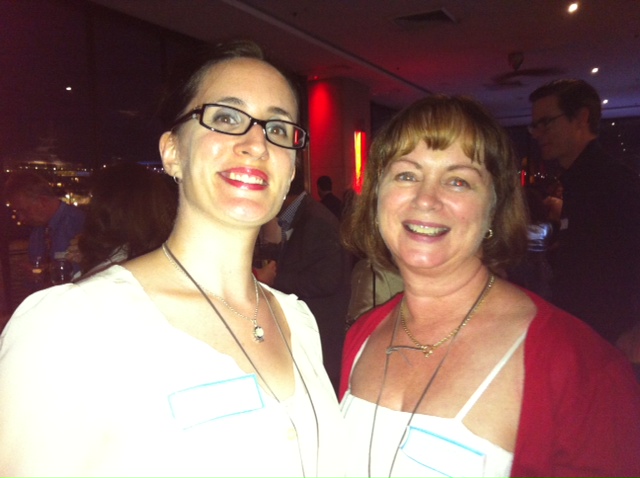
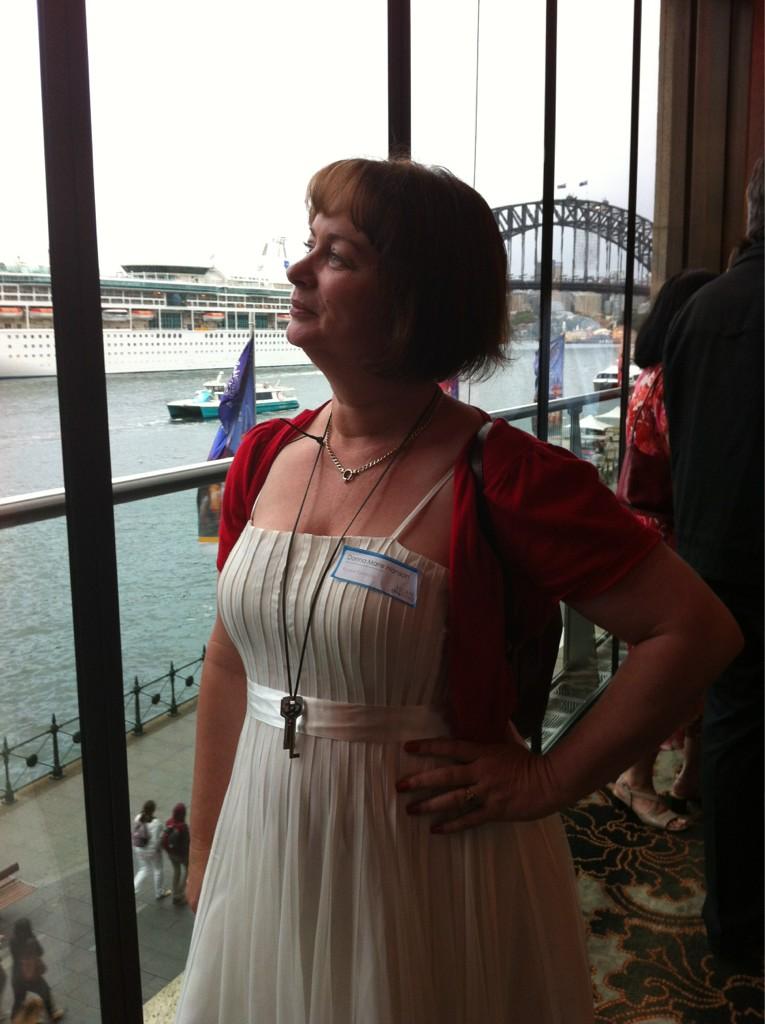
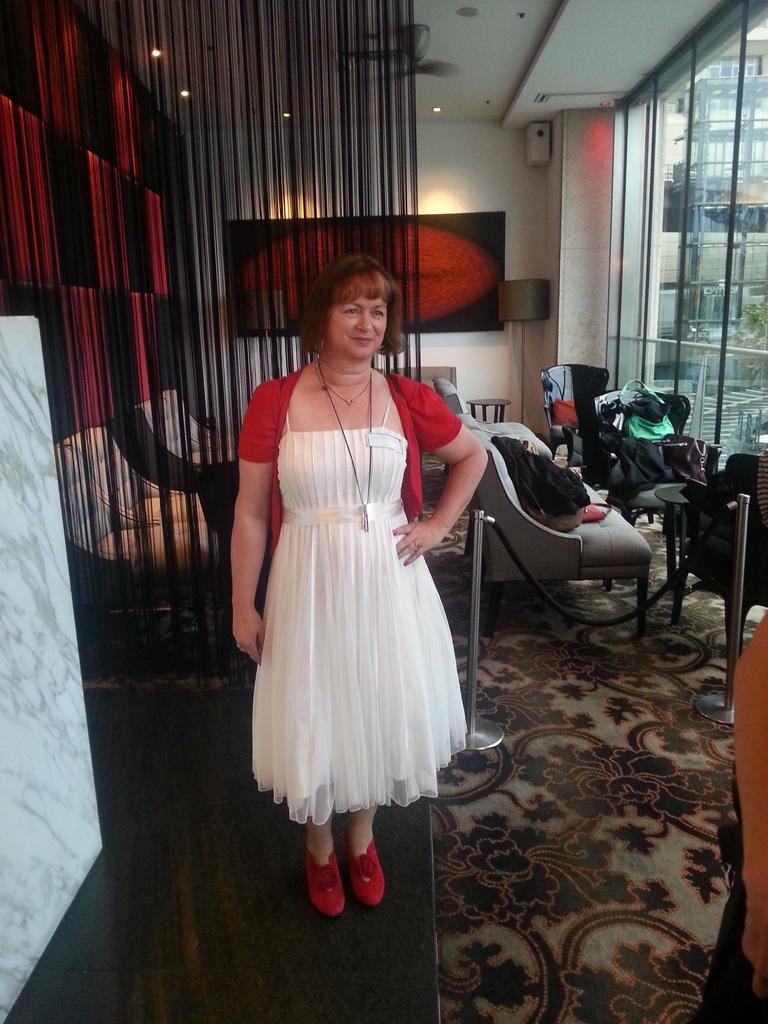
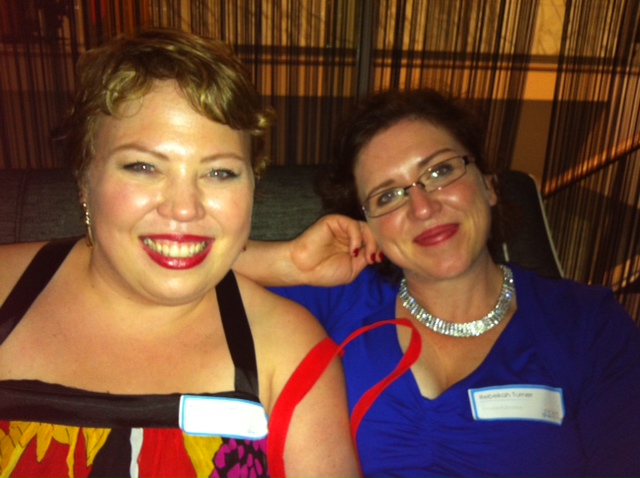
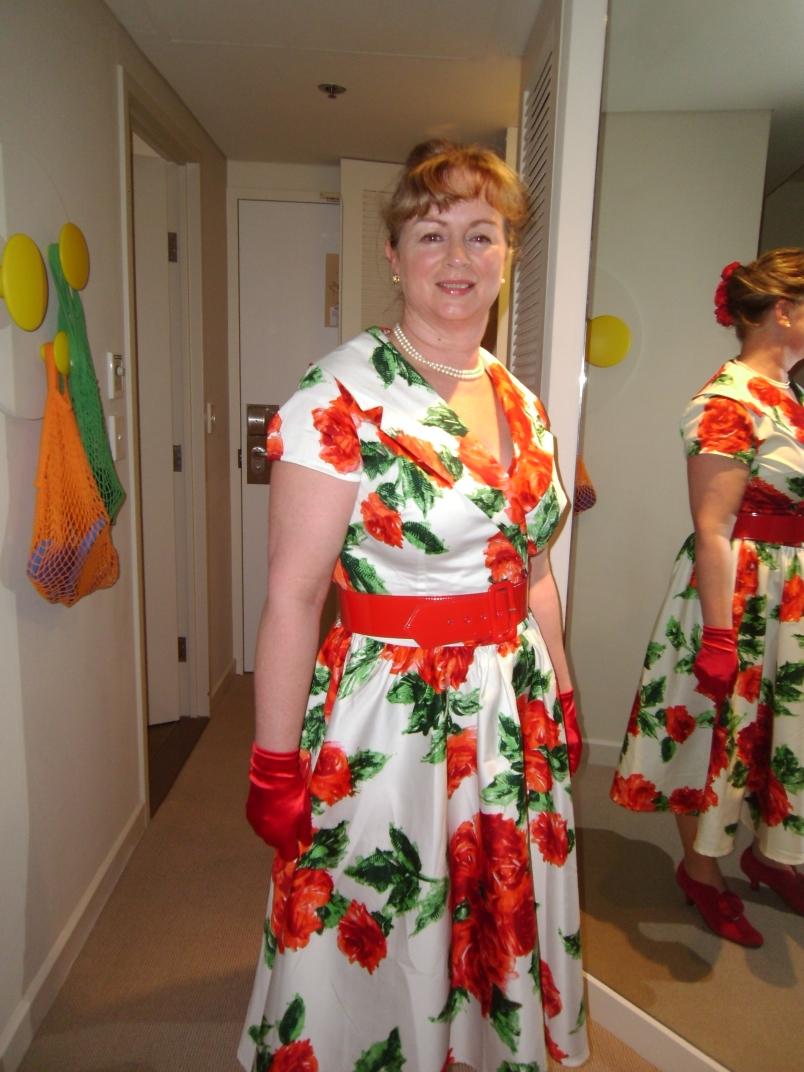
Last night was the Harlequin sponsored cocktail party. I wore an excellent dress. Nicole to a photo so hopefully it is here. (maybe later) I was more like Doris Day than Marilyn Monroe. However, I do like retro- either vintage or reproduction. My dress is reproduction. The cocktail party was fantastic and packed. I wondered about a chatted to a couple of people and also listened to Harlequin talk about their digital first imprint, called Harlequin Escape.

Now that I’ve had my head rearranged, I have some other things that are also romance in my dusty hard drive that I will be reviewing and perhaps submitting.

Today, Nicole invited me to have breakfast at 7.00am with a number of paranormal romance writers and that was cool. I sat down opposite Rowena Cory Daniels and Keri Arthur and got to chat a bit. Nicole and I were a bit queasy from the night before. It could have been the excellent room service we had- bbq beef rib that was a whole chunk of meat in yummy bbq sauce or the canapés or just too much of everything. Then it was the start of the professional development part of the day. Eloisa James did a wonderful and inspiring key note address, then the breakout sessions commenced. I did one on finetuning your suspense delivered by JJ Cooper, author of The Interrogator and Deadly Trust. He had been a military intelligence interrogator so he knew what he was writing about and his presentation was very interesting. He didn’t get through all the presentation because we asked so many questions. It was a very worthwhile session and he has emailed us the presentation.

Next excellent session was Alexandra Sololoff’s Screenwriting Tricks for Authors part one and two. Now there was a workshop on the Friday, which I couldn’t afford to do, so it was great to be able to have these sessions presented as part of the program. Basicall,y what she taught is a plotting/analysis tool, where you divide your story up like a movie is broken up into sequences. She had some terrific tips and I can’t wait to use the tool to analyse what I have done. I think Ruby Heart pretty much meets the analysis, but we’ll see.

Also, while in that session, I had a few epiphanies about myself and how I’m approaching this writing gig. When I first started out I was very enthusiastic and I never wasted a moment on anything else and just wrote. Then after a few years, I think I lost confidence and went into the whole I am not very good etc mode, which I rode as best I could and I never gave up, but nor was I very focussed. I came out of that stage and into the mature stage. Now I see that I have to have a more business-like approach to writing, perhaps something like a business plan. I also need to sit down and do a drafting schedule and plan out what I’m going to be working on during the year. I probably need a spreadsheet to monitor submissions (short and long). I am probably being a little hard on myself as I am just recovering from RSI but I think I need this focus if I’m going to reach my goals. Yes I have goals but I need to acknowledge them more to myself instead of hiding them away. I’ll need this schedule thing because of the Masters in Creative Writing too.

Tonight is the awards dinner. I didn’t buy a ticket as money has been tight this year. So while Nicole frolics with the others, I’m going to write in some capacity. I’m going to order room service first.

Nicole sent me a shot of me in my dress.

Me looking like Doris Day.

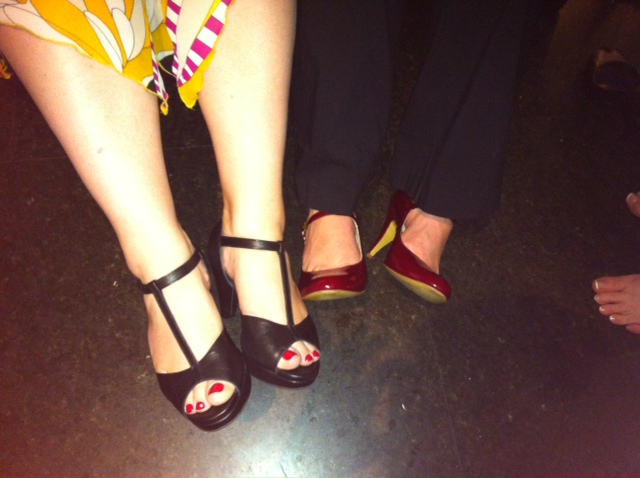
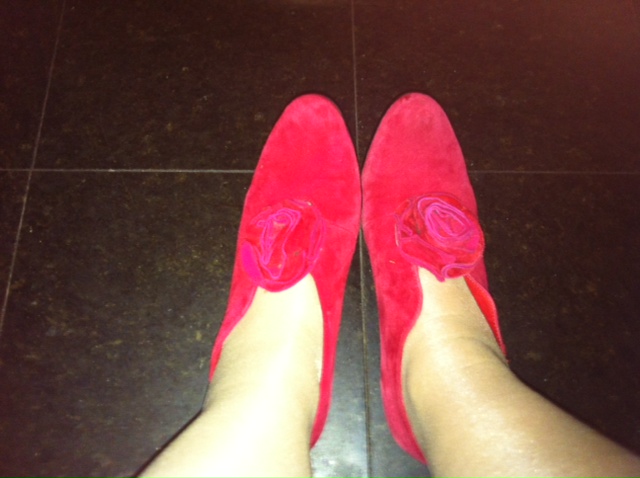
There is lots of red.

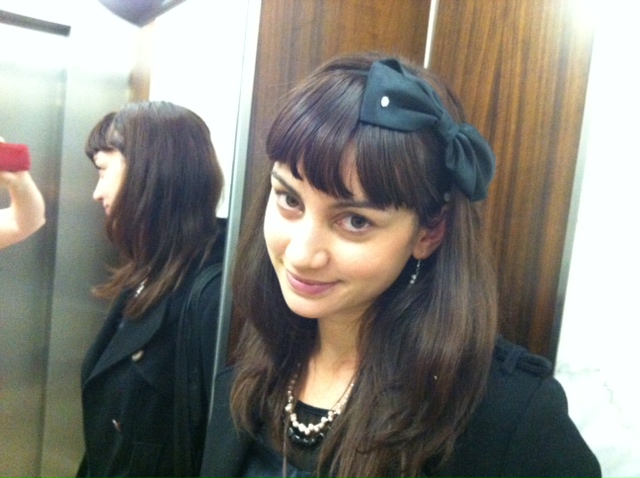
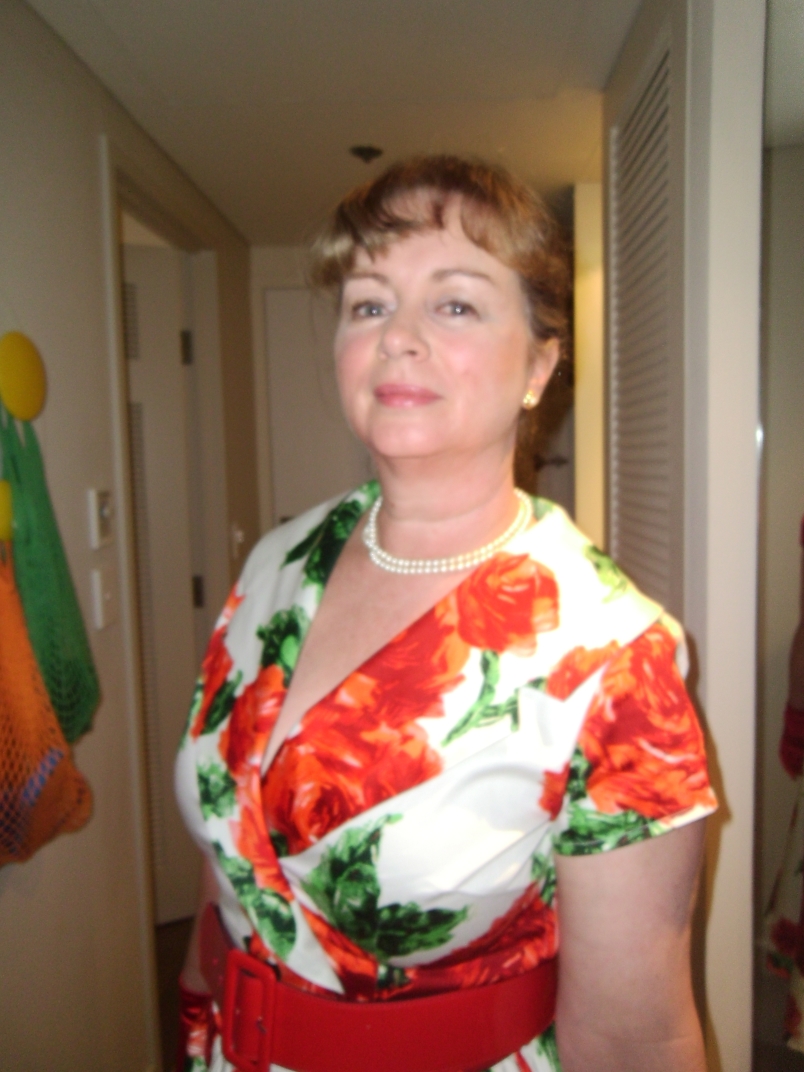
A close up of me taken by Nicole


I am a romance writers’ conference virgin, or newbie. I’ve been a plenty of SF conventions but have not put a toe on the romance side. What an experience it has been so far, even though the actual conference doesn’t start until tomorrow. There have been a number of pre-conference events. I’ll say one thing these romance writers are organised.

I arrived on Thursday afternoon to the QT hotel in the Gold Coast. I missed out on the convention room booking, but ended up with a really cool deal through my Rydges Priority Awards. We have a fantastic room on the 20th floor, with 180 degree views from the ocean across Surfers Paradise and the canals up to the mountains. The weather is fantastic and warm.


Here is a shot of the canals and mountains.

View of the canals with the mountains in the distance.

The romance writers provided an informal ice breaker event last night for the newbies to the romance writers’ conference. It was great to meet people and talk writing. I felt my head expanding as people talked of what they were writing with such terms as romantic suspense or romance crime or romantic comedy. It is bit daunting to know there are around 300 writers here. Also, the ones I met and observed are open, welcoming and articulate. Most of them appear to know what they want and what they are doing. It is also daunting that I only know a handful of people here compared to SF cons where I usually know most people by sight.


Here is a shot of the contents of my goodie bag.

Contents of my Diamonds are Forever goodie bag.


Straight after the icebreaker where I met a range of interesting writers, including a whole bunch from Adelaide, I headed with Nicole into the Penguin event, which was champagne and rather a lot of food. Again I met some interesting people who introduced themselves, inquired where I was from and what I wrote. Then the launch of the Destiny imprint came along with readings etc and still more food coming out. Nicole and I had a free dinner booked at the restaurant so we were trying to say no. After the launch a lady came around enquiring whether we wanted to pitch our novels to Carole George, from Destiny. When I was listening to the readings and also from conversations around me I realised that I could pitch one of my novels, because it had a strong romantic line. So I signed up for a pitch and so did Nicole. As I had been working on a paranormal romance, I didn’t think I’d pitch anything at all, but the lights went on in my head. Yes, that story of mine is also a romance.

We also caught up with Peter Ball who is organising Genrecon in Sydney in November. We had a very interesting conversation-idea creating conversation. Oh dear. I don’t need any more ideas.

We had a fantastic buffet dinner, where we controlled ourselves mostly. Nicole didn’t eat dessert but I indulged. We retired pretty early after talking and reading a bit. I was out like a light apparently.

This morning we went to the beach and had a walk. Nicole put her toes in the water. Her camera died and I forgot my phone. It was lovely. The ocean was a deep green blue and looked so clean. I’m afraid we brought a lot of sand back with us. I didn’t realise it was in my pockets until I lay on my bed. I have sand in my sheets. Eww! We also scored breakfasts with our room booking so we are now completely stuffed with awesome breakfast goodness, which probably isn’t good for us.


Here is a photo of me and Nicole at the beach this morning.

Me at the beach this morning.

Nicole at the beach

So this morning we’ve been sitting here in our hotel room working on our pitches, which is hard work. I’m meant to be writing now that I’m done but I find I’m rather fidgety until I get that pitch over and done with. I’ve not done one of those either. I did a workshop on pitching once but that was yonks ago.

So my star rating for this conference so far is 5 stars. Tonight is a cocktail party, with a 50s movie star theme. I hope to get shots of me in my dress.

Last post I talked about how I hadn’t completed an outline but that I used key questions to work out aspects of the plot for this paranormal romance I’m working on. This seems to be working. I have revised the first part to add additional characters and I find that the questions give me greater clarity with the broader story and world-building, something that I had been a bit sloppy on. Perhaps I never took this story seriously before, even though I think it is a cool idea. Although I like reading paranormal novels, this is my first attempt at one. I have managed a couple of short stories, which were published. I find them an interesting flex of the writing muscles, a chance to dance in the moonlight and let my hair down.

I read the first Dark Brotherhood book, Dark Lover by JR Ward. It was a pretty cool book for a number of reasons. Nowhere near as hot as I expected, but I’m told the series gets hotter. I was a bit taken about by the glossary up front. However, I could see why Ward wanted to differentiate her vampires from the common tropes. She has an interesting world setting, which sets it apart. I thought her approach was clever too. I’m on the second Patricia Briggs Mercy Thompson book, Blood Bound. I’m still trying to figure out how she does it. If there is romance then at this stage it is very low key, just a kind of attraction with a very slow build. With two potential lovers, I’m not sure who I’m backing at this stage. I think it is because Briggs’ world-building is so interesting and immersive and the story is also very pacy. I find this book unputdownable.

Speaking of flexing my writing muscles, I’ve had the first lecture in Writing for Young People yesterday. I’m scared witless. It is an intensive writing course so basically I have to produce product, a kiddie book, a poem based story etc every week. I’m excited by learning something new and exploring new things and I’m also anxious about it. I guess I want to be good at it. I didn’t realise that I had this competitive streak, that I really want to do things well, when I choose to do them. Perhaps that will rub off on my generally because I have been a lazy writer in the past, accepting what I had written without really seeing that I could improve it (not always but I had/have bad habits).

Along with work (I’m writing issues papers again), gym, cake decorating classes (actually I’d call it an expensive addiction), organising Conflux 9 (2013) Natcon with Nicole and life generally, I’m pretty full up. However, I find that being busy makes me productive. Somewhere I have to fit in making a Victorian costume in the next month.

Tomorrow, I explore yet another frontier by heading to the Australian Romance Writers Conference in the Gold Coast. The link to Diamonds are Forever is here. I’m quite excited about going. I don’t know much about the industry but I know I have a number of romance novels in me so yet again I’m flexing those writing muscles by exploring new territory.

Also, it is a bit of a holiday for me.  I’m staying an extra day to hang with Matthew in Brisbane. It is so much warmer there than here.
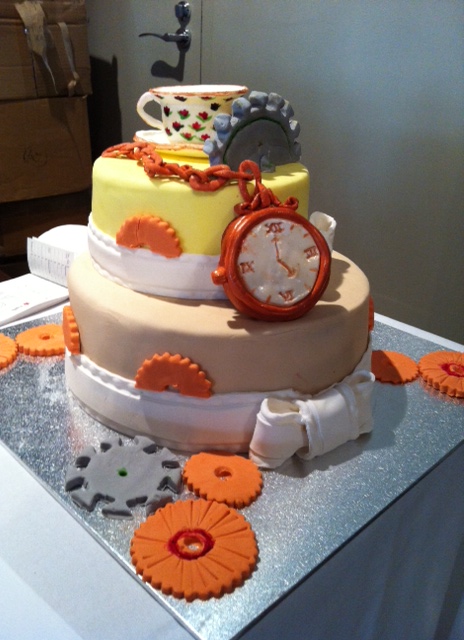
Below is a picture of my first cake. This one has butter cream. The next one will be covered in fondant.

My first cake decorating attempt. The green icing was lime flavoured.

I wrote this post last weekend and it has taken me until now to put it up. I’ve started a cake decorating course, which I’m a bit obsessed with. I’ve been creating fondant bugs and flowers. Today was all about baking and the baking day has been a big fail. Not sure what caused it. Oven settings. Me. So I thought I’d throw this blog up while the second batch of cupcakes are in the oven.

So to outlining…

I think I alluded to the issue in my previous post that I had not written down things about the paranormal romance I’m writing. I’m trying to do remedial outlining lessons and encourage my partner, Matthew Farrer, do a post here or on his blog about how he outlines. As he writes tie-in novels (mostly), they require quite specific outlines to be submitted before the novel is commissioned. Another writer friend also outlines for the novels she is paid to write and I remember her saying to me on one writers’ retreat we were on together: Haven’t you written an outline? I had written something like a short synopsis, which usually has a great introduction and then the ending and nothing in the middle. Not really useful for outlining as it was barely more than an elevator pitch. This probably mirrors the ideas that I have when I write a novel as a pantser—I know where to start and where it ends and the rest just comes.

I’ve been thinking about this lately. This has worked for me in the past where I’ve written the bulk of a novel at a writers’ retreat, two solid weeks of immersion and writing, which allow me to experience a creative ‘zen zone’ that carries me through with the draft. The draft gets revised and tweaked until it works. However, I don’t always have the luxury of going on writers’ retreats for two weeks and what about when I’m writing during the other 50 weeks of the year? Sometimes the impetus from the retreat carries me through, particularly if I’m continuing on with the story. Where it hasn’t seemed to have worked for me is this paranormal fantasy, which I have picked up, started, stopped, put away and pulled out again. The momentum is lost. I know the beginning and the end but what about the in-between bits? I need to write down an outline. I need to decide on the key plot points—like who is the baddy? Why are they the baddy? Why does X choose to do Y? etc.

There was always going to be a point where I hit a wall, where I had to get with the program and do some thinking, do some plotting. So I haven’t quite got an outline written but I have instead written down a series of questions to help me think things through. These questions are things like: Why does X do that? Did the person that killed person b also kill person c? Is the threat internal or coming from outside? (I had to do a serious think here because another novel has a magical society and I had to make sure I’m not doing the same old, same old). Also, I want to make sure that the mystery/thriller aspects of the story are robust. Paranormal romance readers need a good story to hang the romance off. I want to do a good job, of course. This takes serious thinking and hard work—that is the reality of the situation.

So right now I’m having a writing afternoon with Nicole Murphy (link) and I’ve cataloged all my questions and I’ve answered them. By answering them I mean I’ve developed the characters and the plot that will carry my story. I’ve also worked out who the baddies are and what motivates them and that then gives me ideas to fill up some backstory, which I have to go back to the beginning put in. Also this exercise has given me heaps of ideas and structure to go forward with because I have mapped out the essential plot points. Now, I have a worthwhile story to put between the sex scenes. Although, Nicole tells me that I don’t need too much plot between those.

So I’m back to working on my paranormal romance, which I call a paranormal sexmance. It is really pushing the boundaries of erotica, I think, which is okay because that’s all the rage right? It sort of hugs the boundaries, I’m told, because of the bit of kinky sex in it. You see the baddy uses sex to power her magic, or to make it very strong. This causes me problems because there is a lot of sex as a result. (I’m trying to think of a character who hasn’t had sex yet. Oh him…).  My older son (33) said but that was your idea wasn’t it, mum, to make that the baddy’s power? I’m like ,yeah I guess, but really it was a cool idea in the beginning that is causing me problems, or may cause me problems in future. However, I’m not going to worry too much about it now, because the point is to draft the thing and then craft the thing. Sex scenes can be deleted, tension can be created, plot twists can be enhanced etc.  I need the whole thing to balance that and probably about 50 beta readers (lol) to give me hints.
The annoying thing for me is that I don’t think I did an outline. This has caused me problems because I know I worked through the story in my head, and in my head it was pretty brilliant but mmm that was two years ago maybe and I can’t remember key details (if I thought of them). Doh! So biggest lesson write down your ideas, do an outline (you don’t have to stick to it but it helps). So now I’ve edited the bits of what I’ve written so farand I have to write the bit of the story from there until the end. Guess what I haven’t figured out what word length I am aiming for.

Did you know that romance writers are generally clued up to what market they are writing for (category, historical, paranormal etc) and also know what word length etc? Well Ms Casual me is swimming in the mire here. This calls for serious planning, outline, estimated word count and probably an idea of what market I’m aiming for and possible strategies on how to sell it or get an agent. Lucky for me I’m heading the romance writers’ association conference in less than a month so I’m pretty sure I’m going to pick up tips. I need to get more professionally minded about writing and publishing instead of lingering in my imagination dreaming of being published and floating around in stories. This takes effort, of course, and as I’m co-chairing (running) a science fiction convention in April, 2013, my effort will be diffuse until then.

So the other day, I had a bright idea. I will read a paranormal romance that I haven’t read to keep me in the loop about the expectations. I picked up Moon Called by Patricia Briggs and well maybe it wasn’t a paranormal romance after all. I mean no one had sex. So I thought this must be an urban fantasy then. However, there was a lot of sexual tension and all unresolved at the end of the novel. I couldn’t put it down and finished it in two evenings. Needless to say, I’ve ordered the other two books and then I noticed that there is now a whole series of Mercy Thompson stories.

Lesson one-tension. Thanks Patricia.

Briggs used a very clear style and filled in nice, realistic details. I found that rather interesting because my story has some detail but not as much as Briggs. However, the effect was that the detail gave it an air of realism, without affecting the tension.

Lesson two-world building (research). These were things like getting on the freeway, the type of grass that grew in that part of the country, the details of being a mechanic for specific types of cars and nice details of face, clothes and other mannerisms. These I tend to underdo these, I think.

Also, Briggs had a vast array of characters, the main ones very defined, even if told in the first person. She described them from the Mercy’s point of view, but she also let them show themselves through their dialogue and action. Even walk in characters had a distinctive air.

Lesson three-character portrayal, find the little things that make a character stand out, whether its red hair, a slouch or a nasty demeanour.


And still keep the pace going and not get bogged down for paragraphs describing someone etc.

Lesson four-pace. Keep it going. Briggs knows when to dwell on something, and which scenes to milk for effect. Like the alpha using the moonlight and calling the wolves. That was a groovy scene and it was grown for effect. The pace of her story kept me hooked and reading way past my bedtime.

Reading Moon Called did not help me assess the level of sex in my story or the degree of detail when describing sex scenes, but I felt there were valuable lessons in the book for me, which are useful for all forms of writing and it is good to be reminded of them.

I suppose I’ll just have to reread Keri Arthur and hope that some nice readers can recommend some very hot and steamy paranormal romances for me to read for research (cough) purposes.


If you have been reading me you know that I had RSI in December and the issue still remains. I haven’t written anything except one short story in 6 months. Today was to be my first serious writing day as I have reverted to part time hours with Wednesdays off-nominally the writing day. Today happened to be a high pain day and as I’d already taken the new fangled pain killers last night, I can’t take any more till this evening. All I’ve managed was one blog post to wrap up the beta reading series, which has been on my mind now for a number of weeks.

You probably wonder what I’ve been doing while I’ve been so idle. Well reading, beta reading, attending a couple of CSFG crit groups and sewing a Victorian/steampunk outfit. The only short story I wrote, received some very positive feedback from the crit group but was rejected from the anthology I wrote it for. However, I do believe it is a good story and I have a bit of tweaking to do and then I’ll send it out.

I’ve also had two novel manuscripts out with editors. I’ve heard back on one and it’s been passed to the young adult editor. This is both nice and also frustrating. I didn’t think that particular MS was YA. However, I can see how it could be. It wasn’t deliberate. I now have two novels that have been considered to be YA. This wouldn’t be too bad but I don’t know much about the YA market or where best to send the work. I’ll have to do some research.
Despite having made myself a promise to submit to 52 agents this year, I have submitted to none. Facing 52 rejections is a bit daunting when one is struggling to get through the day at the day job sort of works as a counter incentive. However, the year is not over and I think things are looking up. If I think positively about this week for example, I did write a proposal and send off five chapters to an editor.

I’ve also geared up on the tech side. I’ve bought a laptop with grunt, had the professional version of the dictation software installed and bought a high-powered wireless microphone set. In theory there is nothing in my way, except me (and the fact that writing fiction by dictation is something that I haven’t quite grasped).

On discussing what manuscript I should work on with my partner, Matthew Farrer, we decided that I should complete the paranormal romance I started a while back. I have dragged it out. I was lucky to get some feedback and edits on the opening, which I’ve taken up. I even added a couple of thousand words to it. I will keep it on the burner. The reason we chose this is because I’m heading to the Romance Writers Conference in the Gold Coast in August and Matthew thought it would be good if I had a complete romance genre manuscript. Also, erotica sort of seems to be the flavour at the moment. While I’m not trying to write erotica per se, it seems that this story is rather hot, steamy and pushes the boundaries of kink. It is fun and I love my hero and heroine a lot. I just wish I spent more time writing the story than fantasing about it.

I finished up my uni subject on English Grammar with a high distinction. That mark was gratifying because I was working so hard with the day job that I didn’t have much left for study. I’m about to enroll in the last subject in the next week or so or decide to convert to a Masters in Creative Writing. In fact, I’m about to head off to see the course convenor right now. I’m not 100 per cent convinced that I want to commit to the Masters as there are a number of issues, such as the cost (I will have to pay back through loans as I have no more cash), the time (yes it will take time over another couple of years) and value (what will I get out of it?). These are the things I have to weigh up. I have enjoyed the study so far so maybe that is enough.

Finally, Conflux 9, the natcon has been consuming my time too. This workload will increase and I guess I have to acknowledge that working on conventions leaves less time for other things like writing and study. If I do the Masters next year, then Conflux will be done by the end of April so it won’t impinge too much.

Right this minute I’d like to find some perk, some enthusiasm, some real commitment to writing. However, I’m not going to kill myself if I don’t.

This series of interviews on the use of beta readers in the development of manuscripts for publication has been interesting and informative. While the range of usage of beta readers is varied, it is heartening to see that published authors also need input into their manuscripts as well as the new, unpublished novel writers.

For new writers, it is worthwhile to note that those more experienced novelists find critique useful in the writing process. It is also important to understand that accepting feedback on our work is part of learning the craft. To be able to take frank and fair feedback and look at your work dispassionately, is essential for growth as a writer. Few of us, I think, are amazing geniuses whose first act of putting pen to paper reveals a masterpiece. It has taken me quite a few years to realise that. (I knew I wasn’t a genius but it took me a while to figure out there are people who can just create something fantastic with seeming little effort.)

More established writers find that there are other challenges awaiting them such as looming deadlines and the continual time poor situation that creates. Writers who have deadlines and publishing schedules (and all the other things like family, friends and events to go to) do not have the same amount of time to sit on their manuscript and ponder various aspects of the story, characters and narrative as they did when they were trying to get published. For example, I began writing Dragon Wine in 2005 and while I have not consistently worked on it I have had seven years to think about it.

Experience grows with each publication and it is heartening to know that the humble reader can contribute something to the creative process as well as assist the writer to make the manuscript the best it can be in the short time available. For example, both Glenda Larke and D.B. Jackson mentioned that they did not use beta readers as much in their early careers but are finding them more essential at their careers develop. Also, other writers such as Margo Lanagan, Maxine McArthur, Tansy Rayner Roberts, Marianne De Pierres and Richard Harland have benefited from a consistent and professional approach to critiquing each other’s work through their ROR group over many years.

As a writer myself, I find receiving critique useful on many levels. For example, my big, gaping need to know if my story is working on some level and then to find out what’s not working so I can think of ways to fix it. Sometimes, talking to people about a story can identify a problem, which can lead to a raft of ideas to improve the story. Like many of the writers interviewed said— they were happy to hear what the issue might be, but don’t necessarily told how to fix it. Also writing is a very solitary occupation and when unpublished provides all too few rewards or acknowledgements. Feedback in this respect can work as a stopgap, a sort of pat on the back when hearing the good things and reminder that you have more work to do on hearing the bits that aren’t working so well. If you think about it, writers write stories to share and to provide enjoying to their readers generally (well some write to scare the bejesus out of them). So having someone read your work is sharing the work and finding out they enjoyed it can imbue one with an inner glow. I was chatting to Glenda Larke recently after I sent her some feedback. I really didn’t have too much to say, just a few thoughts and feelings, but she said she welcomed them because it helped her make the story the best it can be.

Personally, I found Ian McHugh’s interview as a beta reader very informative (as I thought I would)  and I borrowed some of his ideas for my most recent feedback on a novel I was beta reading.

As part of the wrap up, I would also like to thank the writers who gave freely of their time to answer the questions.

I hope this series of blog interviews on beta readers has been useful and as interesting to you as I have found it. The feedback I have received has been positive in this regard. I will have to put my thinking cap on about other interesting blogs. I have a couple of author interviews in mind so we will see.

Warning. The bulk of this post was dictated. I try to make sure there are no glaring errors but sometimes they slip my guard.

Ian McHugh is an accomplished writer, winning the Writers of the Future award. As well as selling short stories to professional and semi-professional publications, he is also is very generous in sharing his experience and writing insights with others. He is a key figure in the Canberra Speculative Fiction Guild and basically a really good guy.  He is currently coordinating the CSFG novel critiquing group, among other things. I wanted to interview him because we had beta read the same novel and his comments were extremely insightful so I thought his views would be helpful to writers and those thinking of using beta readers or becoming a beta reader. Ian McHugh keeps a blog here.

1. What do you see as the key role for a beta reader?

To help the author find the problems and potential in their book that they’re too close to see for themselves, and to affirm the strengths in their writing and storytelling (that they may or may not be aware of, or entirely convinced of).

 2. What are the types of things you look for when beta reader?

I tend to structure my feedback under a number of headings:

– Plot and structure

– Characters and relationships

– Conflict, tension and threat

– Worldbuilding

– Writing Style

(We’re using these headings in the CSFG novel crit group this year, and it seems to have been useful.)

I tend not to go looking for particular stuff to write under each header. I wait to see what stands out – eg, an aspect of the world that I find implausible, a character I don’t find sympathetic, a plot device that I think is too obvious. Or, of course, a character I think is awesome, an action sequence that kicks arse, a well-executed plot revelation etc.

Often I find that it’s the apparent absences, rather than what’s there, that most catch my attention – eg, a lack of tension at a certain point, an undeveloped relationship between two characters, no obvious protagonist.

I find that structuring my crits under headings helps me to organise my thoughts, although a lot of comments cut across the different sections, too – a lack of strong plot direction and lack of a protagonist go together, unsympathetic characters undermine tension.

Yeah, characters affect pretty much everything, actually.

I also jot down my reactions while reading, particularly to anything that jolts me out of the story, and provide these as well in a line-by-line list.

 3. What is the most difficult part of providing feedback when beta reading?

A) Tempering my inclination to be a smart-arse when saying something uncomplimentary about someone’s manuscript, and expressing myself purely constructively and with sensitivity to their feelings instead.

It’s a lifelong battle and I don’t win every skirmish.

B) The other most difficult part is, when I see and am excited by (what I think is) unrealised potential in some aspect of a story, staying on the right side of the fine line between (i) offering constructive suggestions in case they spark something for the author, and (ii) re-writing their story for them. So:

GOOD: I think there could be some more tension when the ranger and the barbarian go into the dragon’s cave, for example, if you draw out the uncertainty more over whether the dragon is asleep or awake, or the dragon isn’t where they expect it to be and it’s stalking them instead.

BAD: Oo, oo, instead of the ranger and the barbarian going into the cave to slay a dragon, it should totally be a horde of goblins with two or three cave trolls instead. Really huge cave trolls that ate the dragon. That’d be awesome. And the ranger should die. Awesome.

 4. What is the best part about providing feedback when beta reading?

A) Reading a story that is already awesome, and having that to say to the author.

B) When one of my suggestions makes lightning in the author’s brain, and excites them about their next draft.

 5. As a beta reader what benefit do you get in providing critique?

Accumulating reciprocal novel-reading favours.

6. Is beta reading useful to you as a writer?

I think that in getting your work critted, you tend to learn what you need to do to fix that particular story. Whereas, when you’re critically reading someone else’s work, and thinking hard to figure out exactly what it is that seems like it’s not working and why, you’re learning about writing and storytelling generally. So, fingers crossed, critting is making me a better writer.

Ian thanks for that. An excellent perspective to help tie up the series. I find I’m in accord with most of what you say. I have something to learn about structuring my feedback and I will take on board some of your approaches.

Donna

Kaaron Warren and I go way back. Kaaron has published over 70 short stories in about 20 years, has had three novels and three short story collections published. She is renowned for her horror writing, but if you read all of her work you will realise that she is a versatile writer able to write across many genres. Personally, I’m in awe of her ability to think and write outside the square and placing a very unique stamp on her work. You can find out more about Kaaron here.

1. How many beta readers do you have and how long have you used beta readers in your writing process?

I’ve used beta readers for as long as I’ve been writing stories. I wrote a novel at 14 and handed it out to trusted friends for feedback! These days, I have three or four readers for longer pieces, and often only one for a shorter piece.

2. In what ways do beta readers assist you in developing your novel for publication?

They identify plot flaws. Let you know if characters resonate with them. Tell you the logic flaws and the gaps in your research. Make suggestions for improvements in plot, naming and pacing.

3. Do all your beta readers pick up the same points?

Sometimes they do, and if so you know you probably should listen to them. Other times, they pick up small things, and rarely replicate these. I think this is because we all have different experiences in life, and we have different levels of knowledge as well.

4. Do you sometimes target your beta readers to particular areas based on the experience you had with them in the past? For example, one reader is good at plot holes, another reader is good at grammatical issues and another might be good at style. Or do you take what comes?

I take what comes. My three main readers are honest and direct, and none of them are writers. I look to them purely for the readers’ opinion and I think this works very well for me. They are all three instinctive story-tellers, though, because they will identify issues any long-term writer would pick up.

5. Do you always want the same thing from the beta reader for each novel? For example, when you have deadlines and only have time for high-level feedback?

Often they’ll see a very early draft, before deadlines are looming too hard. This helps me identify issues early in the piece, rather than later when the panic starts to hit

6. How hard is it to find a good beta reader?

It’s tricky. You have to respect the person’s opinion, and they have to have the time to give it to you! Not everyone agrees on what makes a good story, so you need to keep trying until you find someone who will give their opinion without trying to change what you’re doing.

7. Do you have any advice for readers who want to be beta readers or even editors in the long run? For example, what type of commentary to you prefer?

Be honest and direct, but not cruel. I hate sarcastic comments in the margins!

If it occurs to you, note it down, but with a question mark if you’re not sure.

Don’t try to take over the story, or change it to the way you would have written it, unless the story falls very badly and you can clearly see where it should feel. Keep yourself out of it.

If you really love something, make a note. There have been times these little notes have sustained me through the next draft, and they are an indicator of what works.

Thank you Kaaron for responding to the questions.