Feeds:
Posts
Comments

Archive for the ‘Interviews’ Category

The other week I was interviewed by the lovely Helen Stubbs for Galactic Chat. We talked about a range of writing related things, Rayessa and the Space Pirates, the difficulties writing the sequel, using a pseudonym for my paranormal romance work, using dictation software and also about things I’d either watched or read. With regard to reading, I mentioned reading Anna Cowan’s Untamed, a fresh and interesting take on Regency Romance. I think it’s more fringe Regency, with a cross-dressing duke and a barely there lady. I was mesmerised by it. I had also just bought A Single Girls Guide to the Zombie Apocalypse by JT Clay, out with Momentum Books. A zany sounding book, packed full of fun.

Anyway, I have to get to work. I am moving house over the next week. I’m moving in with my partner of four years in a big house in Canberra.

Here is the link to the Galactic Chat interview.


BTW Did I mentioned I handed up the last of my Masters of Creative Writing assignments? All done!

Read Full Post »

Thank you to Amanda Bridgeman for tagging me. I’m afraid I’m going to let the side down because every author I contacted had been tagged already so I don’t have the full complement of five authors.

1)      What is the working title of your next book?

This is a hard question as I have a few things on the boil. Rayessa & the Space Pirates comes out on the 10th of January and I have a few other things in the works. I’d have to talk about the book I’m currently drafting I think. It’s working title is Bespelled and it’s a romance with a paranormal slant. I’m aiming for a category length work (50,000 words) and I’m just over half way. I’m hoping to finish it by the end of December. I was going to say Christmas but that’s probably pushing it as that’s a week away and I don’t go on holidays until Friday.
2) Where did the idea come from for the book?

I was at the Romance Writers of Australia Conference in August. I had a fab time btw. In one of the panel sessions an editor said she’d like to see more stories with witches. As I was leaving the conference I got the idea about a story featuring a witch and I wrote an outline on the train to the airport, in the airport lounge, on the plane etc. I have to admit to being influence by Bewitched with this one. By the time I landed in Canberra I had written the 3000 word outline. Funny I don’t usually do outlines but I knew I couldn’t start it straight away. Interestingly, I deviated a little from the outline in the way I revealed things and the timing. However, what I’ve written is better than the outline I reckon.
3) What genre does your book fall under?

Paranormal romance, category length.
4) What actors would you choose to play the part of your characters in a movie rendition?

Ooh that’s tough but fun. I borrowed the images from IMDB. I went with Australian actors as the story is set in Australia.

Alex O’Loughlin as Jake, Abbie Cornish as Elena, and Rose Bryne as Grace, Elena’s cousin.

Alex O'Loughlin Picture.Image of Abbie CornishRose Byrne Picture
5) What is the one-sentence synopsis of your book?

Suburban witch, Elena Denholm, has to mind top flying lawyer, Jake Royston, who has been hexed by a love spell, except she’s finding it hard to keep him out of her bed.
6) Will your book be self-published or represented by an agency?

I haven’t finished it yet but I’ll probably submit it to a publisher and go from there or maybe by some miracle I’ll have representation. I wanted to have a couple of new manuscripts to shop around in the new year. I’ll have two newly written ones and some other ones that I’m trying to sell.
7) How long did it take you to write the first draft of the manuscript?

Hahaha. Not very long but it’s not finished yet. I started it in October during my visit to New Zealand and then picked it up again mid-to-late November, I think. I was working on another novel before that. I seem to be on a paranormal romance gig at present. I was hoping to finish it in 6 weeks but I didn’t. You could say I was slack.
8)  What other books would you compare this story to within your genre?

Actually I have no idea. It’s  hot and may even be classed as erotica, depending on the publisher and what final form it takes.
9) Who or what inspired you to write this book?

Well let me see. Romance Writers of Australia, Nicole Murphy because she encouraged me to go there. My editor, Kate Cuthbert, indirectly because she acquired Rayessa & the Space Pirates and that encouraged me to try writing romance. Also, I’d finished writing a longer single title work, which was a paranormal romance and that worked out well so far. The beta reader comments say so.
10) What else about the book might pique the reader’s interest?

It will be compact, sexy and funny too. All set in Sydney.

So that’s my Next Big Thing interview. Around the 26th of December you will be able to see the interviews from my tagged authors.

Ross Hamilton

http://rosshamilton.net.au/

Maxine McArthur on her new blog.

https://maxinemcarthur.wordpress.com/

And others who might be found before the 26th.

Read Full Post »

So over on Nicole Murphy’s blog, I’m being interviewed about how I got a publishing deal as part of Nicole’s ‘The Call’ series.

The blog interview is here.


In other news, my son, Taamati, came over to take some author shots. He’s pretty busy at the moment but he has to do things to them, including cropping and colour correction etc. So I could only choose 3 author shots.

Here is one that didn’t take the shot. I like it because it is out there.

Me in my not author shot

Read Full Post »

I am very pleased to bring you this interview with Rebekah Turner, an exciting Brisbane writer on the scene with Harlequin’s new digital imprint, Escape Publishing. I was introduced to Rebekah at Genrecon, as a fellow author. (Yes, there is a gleeful squee in that) and I was looking forward to read her urban fantasy, Chaos Born.

Chaos Born is a good example of the difference between paranormal romance and urban fantasy. Love is not the central driver in this story. There’s some sexual attraction and some ‘pinch and tickle’ and a maybe a promise of a happy ever after in a later tome. This story is hard hitting, gritty and complete with a quirky female, kick-arse heroine with attitude. The heroine, Lora Blackgoat is flawed, funny and frankly in a lot of trouble. Rebekah takes the tropes and puts them through a mangler, then she twists them, smashes them into the pavement then slaps them onto her broad canvas.  She has goblins, elves, half-angels, witches and demons and she makes it work in this fantastical place.

I had trouble putting this book down. This book rocks and the production is good. Congratulations and well done to Rebekah.
You can get Chaos Born from the Escape Publishing website here. Or from Amazon, Barnes & Noble, ibooks and other retailers of digital books. It was on special but it is now $4.99.

Rebekah thank you for letting me interview you .

So tell us a bit about yourself.Chaos Born

I live in Brisbane with my husband, two kids and a psychotic Boston Terrier. In my past I’ve worked as a graphic designer in the corporate world. I now work part-time and spend rest of the week being a child-wrangler and house-witch.  

How long have you been writing for?

I started writing when I was young, maybe around primary school. I loved creating stories and usually had illustrations that accompanied the fantastic tales of magical horses and snarky dragons.

What kind of genres to you write?

I enjoy making things up, so all things paranormal interest me. I also like a tasty romance. My first big story was a bloated fantasy mess, called Bane of the Flamebird. I wrote it in high school in my lunch break. It was about a girl in high school (cough, cough) who gets transported to a magical fantasy land. Once there, she had to find some magic McGuffin to get back home.
When did you start writing Chaos Born?
I wrote Chaos in 2008, when doing Year of the Novel with Kim Wilkins. It was originally straight up fantasy, and written in third person. After it was finished, I let it rest while I tinkered on other stories. Then I gravitated back to the story, because I’d had a lot of fun creating the world and the characters, but knew the story wasn’t quite right. In particular, the protagonist, Lora Blackgoat, was flat and uninteresting. So I re-wrote the story from her point of view and she emerged as a cranky anti-heroine that I found hilarious to write.

Do you have other novels in progress or is Chaos Born you first? (If you have others tell us a bit about those).

Other than a few short stories and book 2 in The Chronicles of Applecross series, I’ve been working on a sexy paranormal romance. The working title is Biker Werewolves in Tasmania and involves an ex-homicide detective who comes to her home town to recuperate after job burn-out, and a disgraced werewolf pack enforcer.

The Weald is a very fantastic place, with creatures from legend, steampunk, magic, half-angels and religion all blended in. Was this how it started out for you or did you end up with that mix?

The world evolved as I edited the story, but the creatures from legend and the religious aspect were always there. I used a few techniques I found online to flesh the world out more and did up a kind of scrapbook to help visualise what Harken City looked like. I wanted the city to be fantastic, but in a realistic sense.

Lora is such a likable but flawed character. She sounded fun to write? How long and how hard was it to get her just so?
Lora took a while to develop. I knew the type of anti-heroine I wanted, but she was difficult to get a handle on at first. The male characters came easier to me, while Lora read very flat. But I persevered and finally her voice came through after I re-wrote the story from her POV.

Her circumstances are quite out of the ordinary even for an urban type fantasy or even fantasy. She was adopted by a Satyr and an elf witch. I’m sorry to ask this question but how do you think that shit up?

Not sure. Though I didn’t have a television set when I was a kid, and had no brothers or sisters until I was seven years old. So I read. A lot. I used to wake up at 4 am so I could read more. I was also a huge C.S. Lewis and Robert Jordan fan-girl.

So how many goes did it take for Chaos Born to get accepted?
I submitted Chaos Born to publishers and agents when they had their doors open. Took about a year of rejections until it was accepted for publication by Escape Publishing, which was VERY exciting.

How did you manage to get through the disappointments? Did you have mentors and support groups to keep your spirits high?
I’m a member of a writing group called Sisters of the Pen and their support was fantastic. Chaos Born was a finalist in the 2010 Hachette/Queensland Writers Centre Manuscript Development Program. While Hachette didn’t pick Chaos up for publication, it was validation that I had a good story. The constant rejections were depressing, but I always managed to bounce back.

Where did you hear about the opportunity with Escape Publishing?

At the 2012 Romance Writers Convention at the Gold Coast. A panel of publishers pitched to the conference on why writers should submit their manuscripts to them. After hearing the Escape editor say they had a two week response time, I jumped at the chance to submit.

How did it feel to have Escape Publishing accept the MS?

Pretty awesome. It happened very fast and took a long time to sink in.
I believe you are working on a sequel? Can you give us any hints (without spoiling Chaos Born?)
The second story revolves around Lora killing a crazed griorwolf in self-defense. His grieving mother hires Lora to find out what happened to her son to turn him into a killer. Lora’s investigations put her into the crosshairs of the violent Reaper Street Gang and a corrupt city official with a taste for blood sport. Lora’s relationship with Roman deepens, and Seth, alarmed at the deepening affection between the two, redoubles his efforts to win Lora.

Thank you Rebekah for taking the time to be interviewed. I just hope you know that you interrupted my writing today ( on my writing day) because I had to finish the book. Now I have to hang out for the next one. I know you won’t mind, Rebekah, if I say I have a girl crush on Lora.

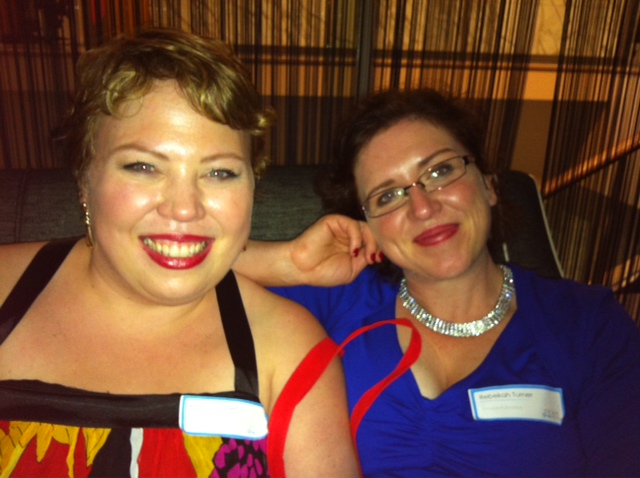
Here is a shot of Kate Cuthbert and Rebekah resting their feet after a hard day during the launch of Harlequin Escape in Sydney on 14  November.

Kate Cuthbert and Rebekah Turner

Read Full Post »

This series of interviews on the use of beta readers in the development of manuscripts for publication has been interesting and informative. While the range of usage of beta readers is varied, it is heartening to see that published authors also need input into their manuscripts as well as the new, unpublished novel writers.

For new writers, it is worthwhile to note that those more experienced novelists find critique useful in the writing process. It is also important to understand that accepting feedback on our work is part of learning the craft. To be able to take frank and fair feedback and look at your work dispassionately, is essential for growth as a writer. Few of us, I think, are amazing geniuses whose first act of putting pen to paper reveals a masterpiece. It has taken me quite a few years to realise that. (I knew I wasn’t a genius but it took me a while to figure out there are people who can just create something fantastic with seeming little effort.)

More established writers find that there are other challenges awaiting them such as looming deadlines and the continual time poor situation that creates. Writers who have deadlines and publishing schedules (and all the other things like family, friends and events to go to) do not have the same amount of time to sit on their manuscript and ponder various aspects of the story, characters and narrative as they did when they were trying to get published. For example, I began writing Dragon Wine in 2005 and while I have not consistently worked on it I have had seven years to think about it.

Experience grows with each publication and it is heartening to know that the humble reader can contribute something to the creative process as well as assist the writer to make the manuscript the best it can be in the short time available. For example, both Glenda Larke and D.B. Jackson mentioned that they did not use beta readers as much in their early careers but are finding them more essential at their careers develop. Also, other writers such as Margo Lanagan, Maxine McArthur, Tansy Rayner Roberts, Marianne De Pierres and Richard Harland have benefited from a consistent and professional approach to critiquing each other’s work through their ROR group over many years.

As a writer myself, I find receiving critique useful on many levels. For example, my big, gaping need to know if my story is working on some level and then to find out what’s not working so I can think of ways to fix it. Sometimes, talking to people about a story can identify a problem, which can lead to a raft of ideas to improve the story. Like many of the writers interviewed said— they were happy to hear what the issue might be, but don’t necessarily told how to fix it. Also writing is a very solitary occupation and when unpublished provides all too few rewards or acknowledgements. Feedback in this respect can work as a stopgap, a sort of pat on the back when hearing the good things and reminder that you have more work to do on hearing the bits that aren’t working so well. If you think about it, writers write stories to share and to provide enjoying to their readers generally (well some write to scare the bejesus out of them). So having someone read your work is sharing the work and finding out they enjoyed it can imbue one with an inner glow. I was chatting to Glenda Larke recently after I sent her some feedback. I really didn’t have too much to say, just a few thoughts and feelings, but she said she welcomed them because it helped her make the story the best it can be.

Personally, I found Ian McHugh’s interview as a beta reader very informative (as I thought I would)  and I borrowed some of his ideas for my most recent feedback on a novel I was beta reading.

As part of the wrap up, I would also like to thank the writers who gave freely of their time to answer the questions.

I hope this series of blog interviews on beta readers has been useful and as interesting to you as I have found it. The feedback I have received has been positive in this regard. I will have to put my thinking cap on about other interesting blogs. I have a couple of author interviews in mind so we will see.

Warning. The bulk of this post was dictated. I try to make sure there are no glaring errors but sometimes they slip my guard.

Read Full Post »

Ian McHugh is an accomplished writer, winning the Writers of the Future award. As well as selling short stories to professional and semi-professional publications, he is also is very generous in sharing his experience and writing insights with others. He is a key figure in the Canberra Speculative Fiction Guild and basically a really good guy.  He is currently coordinating the CSFG novel critiquing group, among other things. I wanted to interview him because we had beta read the same novel and his comments were extremely insightful so I thought his views would be helpful to writers and those thinking of using beta readers or becoming a beta reader. Ian McHugh keeps a blog here.

1. What do you see as the key role for a beta reader?

To help the author find the problems and potential in their book that they’re too close to see for themselves, and to affirm the strengths in their writing and storytelling (that they may or may not be aware of, or entirely convinced of).

 2. What are the types of things you look for when beta reader?

I tend to structure my feedback under a number of headings:

– Plot and structure

– Characters and relationships

– Conflict, tension and threat

– Worldbuilding

– Writing Style

(We’re using these headings in the CSFG novel crit group this year, and it seems to have been useful.)

I tend not to go looking for particular stuff to write under each header. I wait to see what stands out – eg, an aspect of the world that I find implausible, a character I don’t find sympathetic, a plot device that I think is too obvious. Or, of course, a character I think is awesome, an action sequence that kicks arse, a well-executed plot revelation etc.

Often I find that it’s the apparent absences, rather than what’s there, that most catch my attention – eg, a lack of tension at a certain point, an undeveloped relationship between two characters, no obvious protagonist.

I find that structuring my crits under headings helps me to organise my thoughts, although a lot of comments cut across the different sections, too – a lack of strong plot direction and lack of a protagonist go together, unsympathetic characters undermine tension.

Yeah, characters affect pretty much everything, actually.

I also jot down my reactions while reading, particularly to anything that jolts me out of the story, and provide these as well in a line-by-line list.

 3. What is the most difficult part of providing feedback when beta reading?

A) Tempering my inclination to be a smart-arse when saying something uncomplimentary about someone’s manuscript, and expressing myself purely constructively and with sensitivity to their feelings instead.

It’s a lifelong battle and I don’t win every skirmish.

B) The other most difficult part is, when I see and am excited by (what I think is) unrealised potential in some aspect of a story, staying on the right side of the fine line between (i) offering constructive suggestions in case they spark something for the author, and (ii) re-writing their story for them. So:

GOOD: I think there could be some more tension when the ranger and the barbarian go into the dragon’s cave, for example, if you draw out the uncertainty more over whether the dragon is asleep or awake, or the dragon isn’t where they expect it to be and it’s stalking them instead.

BAD: Oo, oo, instead of the ranger and the barbarian going into the cave to slay a dragon, it should totally be a horde of goblins with two or three cave trolls instead. Really huge cave trolls that ate the dragon. That’d be awesome. And the ranger should die. Awesome.

 4. What is the best part about providing feedback when beta reading?

A) Reading a story that is already awesome, and having that to say to the author.

B) When one of my suggestions makes lightning in the author’s brain, and excites them about their next draft.

 5. As a beta reader what benefit do you get in providing critique?

Accumulating reciprocal novel-reading favours.

6. Is beta reading useful to you as a writer?

I think that in getting your work critted, you tend to learn what you need to do to fix that particular story. Whereas, when you’re critically reading someone else’s work, and thinking hard to figure out exactly what it is that seems like it’s not working and why, you’re learning about writing and storytelling generally. So, fingers crossed, critting is making me a better writer.

Ian thanks for that. An excellent perspective to help tie up the series. I find I’m in accord with most of what you say. I have something to learn about structuring my feedback and I will take on board some of your approaches.

Donna

Read Full Post »

Kaaron Warren and I go way back. Kaaron has published over 70 short stories in about 20 years, has had three novels and three short story collections published. She is renowned for her horror writing, but if you read all of her work you will realise that she is a versatile writer able to write across many genres. Personally, I’m in awe of her ability to think and write outside the square and placing a very unique stamp on her work. You can find out more about Kaaron here.

1. How many beta readers do you have and how long have you used beta readers in your writing process?

I’ve used beta readers for as long as I’ve been writing stories. I wrote a novel at 14 and handed it out to trusted friends for feedback! These days, I have three or four readers for longer pieces, and often only one for a shorter piece.

2. In what ways do beta readers assist you in developing your novel for publication?

They identify plot flaws. Let you know if characters resonate with them. Tell you the logic flaws and the gaps in your research. Make suggestions for improvements in plot, naming and pacing.

3. Do all your beta readers pick up the same points?

Sometimes they do, and if so you know you probably should listen to them. Other times, they pick up small things, and rarely replicate these. I think this is because we all have different experiences in life, and we have different levels of knowledge as well.

4. Do you sometimes target your beta readers to particular areas based on the experience you had with them in the past? For example, one reader is good at plot holes, another reader is good at grammatical issues and another might be good at style. Or do you take what comes?

I take what comes. My three main readers are honest and direct, and none of them are writers. I look to them purely for the readers’ opinion and I think this works very well for me. They are all three instinctive story-tellers, though, because they will identify issues any long-term writer would pick up.

5. Do you always want the same thing from the beta reader for each novel? For example, when you have deadlines and only have time for high-level feedback?

Often they’ll see a very early draft, before deadlines are looming too hard. This helps me identify issues early in the piece, rather than later when the panic starts to hit

6. How hard is it to find a good beta reader?

It’s tricky. You have to respect the person’s opinion, and they have to have the time to give it to you! Not everyone agrees on what makes a good story, so you need to keep trying until you find someone who will give their opinion without trying to change what you’re doing.

7. Do you have any advice for readers who want to be beta readers or even editors in the long run? For example, what type of commentary to you prefer?

Be honest and direct, but not cruel. I hate sarcastic comments in the margins!

If it occurs to you, note it down, but with a question mark if you’re not sure.

Don’t try to take over the story, or change it to the way you would have written it, unless the story falls very badly and you can clearly see where it should feel. Keep yourself out of it.

If you really love something, make a note. There have been times these little notes have sustained me through the next draft, and they are an indicator of what works.

Thank you Kaaron for responding to the questions.

Read Full Post »

Karen Miller has kindly agreed to be interviewed and she has provided some in-depth answers on her views on beta readers and the writing process.
Karen is one of the most hardworking authors I know. I have known her to spend a science fiction convention in her room because she has a deadline. She is also very generous with guidance and advice to newer writers. Karen writes under her own name, ranging from her fantasy series, Kingmaker, Kingbreaker and the Godspeaker to Star Wars and Stargate tie ins. Under the name K.E. Mills she has published the Rogue Agent series. Her latest release is Wizard Uncovered. You can find more about Karen here.  Karen is the Australian Guest of Honour at the Australian National Science Fiction Convention to be held over Anzac weekend in Canberra 2013.

  1. How many beta readers do you have and how long have you used beta readers in your writing process?

The number of readers I use fluctuates from project to project. Right now I have 7 on tap for the current work in progress. I’ve always used at least one. No matter how much experience you have, no matter how many books you’ve written,  you can’t accurately assess your own work. You need an uninvolved outside perspective to help you catch the blodgy bits your brain’s skated past. And it does always skate!

 2. In what ways do beta readers assist you in developing your novel for publication?

Beta readers are a mirror. Because they don’t know the story, and haven’t been involved in the creation of the story, they can give you the most objective feedback on the story. A good beta reader, someone who focuses on the reading experience,  is able to point out what doesn’t make sense, what doesn’t ring true, inconsistencies, where they got bored, where they stopped caring, where you’ve made a factual error, where they were engrossed, which characters they loved, which they hated, and ultimately whether or not the story worked for them. All of this information is crucial to a writer, because we’re storytellers, we’re crafting a tale for an audience. So an idea of audience reaction to the earlier version/s is key to polishing the story so it can shine.

3. Do all your beta readers pick up the same points?

No, which is the beauty of a range of readers! Nobody reads the same story in the same way. What delights one reader will disgust another, what one reader finds engrossing will bore another to sobs. One reader will believe something that another reader will disbelieve. Some readers are really good with continuity, others with structure, others with timing. So at the end of the process you’ve got this amazing 360 degree view of the work. The key is knowing how to interpret the feedback. If you find there’s a consistent theme running through the feedback, as in, everybody was bored to sobs in chapter 5, you can pretty much guarantee you’ve got  a rewrite ahead of  you. But if one reader is particularly sensitive to, say, violence against children, if they complain about it you might need to consider what you do. It’s a case of weighing personal preferences against what you’re trying to achieve in the story. A personal taste vs execution issue. You can’t write your story catering to every single personal taste out there, but you can do your best to craft the work so that readers whose personal tastes coincide with yours get the best book you can write.

4. Do you sometimes target your beta readers to particular areas based on the experience you had with them in the past? For example, one reader is good at plot holes, another reader is good at grammatical issues and another might be good at style. Or do you take what comes?

No. For me, the first rule of finding a beta reader is: Do they like what I do? If they don’t like what you write, even if they like you personally, there’s no point. Nothing you do will ever please them, and the feedback you receive will only be demoralising.  So with that on board, I just ask my beta readers to start reading, stop if they hate it, and make a note of things that jar for them. Every piece of feedback has value, so I try not to be prescriptive. When you know your beta readers, you know the things that will catch their attention, so I like to trust in that process.

5. Do you always want the same thing from the beta reader for each novel? For example, when you have deadlines and only have time for high-level feedback?

 Again, books are such complex things. If someone’s willing to give up their time to help me do a better job, I try not to tell them how to do their job. Once the first reading is done, if I need clarification on a criticism I’ll request more information. But because it’s a big job, and a sacrifice of time, and a huge personal favour, I try not to front load the request with a lot of rules and requirements. In between reading jobs, I’ll have a chat about the process if there’s been any confusion.

 6. How hard is it to find a good beta reader?

I’ve been blessed with my beta readers, and I didn’t find it hard at all. I think mainly because the people I’ve asked are familiar to me, they’re people whose reading skills I trust, and who I know will be absolutely honest with me. And also, I hope that I honour their hard work by staying open minded and listening to the hard stuff.

7. Do you have any advice for readers who want to be beta readers or even editors in the long run? For example, what type of commentary to you prefer?

The biggest thing for me is that the people reading my work are readers who have signed on for my story. If you can’t offer feedback that doesn’t morph into you trying to get the author to tell the story the way you’d tell it, then step off the bus. A beta reader and editor’s job is to help the writer tell their story the best way they can.

Once that’s established, the next most important thing is honesty. You must be able to say what you really think and feel. There are times when a writer says he or she wants honest feedback, but they’re kidding themselves. What they want is undiluted praise. That’s not what the beta reading process is about, and if you suspect the person you’re reading for is only after a shower of compliments — again, step off the bus. And if this person is a friend, before you start you need to be sure that the friendship will survive your honest feedback. My primary beta reader is a woman I’ve been friends with since 1982. She puts red lines through entire pages and says, That’s crap, you can do better, start again. And because I know she respects me and the work, and only wants me to do well, and I know that, and I respect her ability to read a manuscript critically, it’s a great partnership. That’s an ideal beta reader. Fearless, and coming from a place of respect.

And speaking of honesty, accept that the writer might not take on board everything you say. Sometimes the feedback is about personal taste and not execution, and the writer must be free to follow their own story truths. If you’re going to be offended and angry that every point you make isn’t acted upon, step off that bus. Ego has no place in the process, be it the reader’s or the writer’s. But, having said that, if it becomes clear to you that your hard work is unappreciated because all the writer wanted was praise? Chalk it up to experience and move on.

Also? Most writers don’t want you to tell them how to fix what’s wrong. They just need to know what’s wrong that needs fixing. You need to be accurate and concise. I lost interest at this point. I didn’t believe Character A would do this, because back in chap 9 you told me this about her. I don’t understand how that bit happened. HIghlight what you feel are areas of weakness in the ms, then leave it up to the writer to do the fixing. Unless you’ve noted a concrete factual error, in which case provide the right info and then leave it up to the author to act on it.

Finally, don’t ever forget that this is a huge matter of trust. Stephanie Meyers had a beta reader who leaked her work to the internet. It was a terribly destructive experience for her, a really wicked thing for that person to do. Please, remember that you’ve been given access to something special and don’t ever abuse the privilege of reading a work in progress.

As a writer, I’d be in a heap of trouble without the talented and generous people who beta read my work. And as a beta reader for other people, I am so humbled that they’d trust me to look at their work and offer an opinion. When it’s done right, everyone walks away a winner.
Thank you for the interview Karen. I have included a snap here of Karen Miller taken at Devention, (the World con held in Denver a few years ago). This was a rare glimpse of Karen at the convention because she spent most of it rewriting a novel. She will probably smack me for putting this up, but hey, considering she had hardly any sleep or rest, she looks pretty happy and good.

Donna

Read Full Post »

After a bit of prodding, New Zealand author Russell Kirkpatrick has provided some answers to my questions. As we are friends, I can tease a little bit.

An award winning author, Russell wrote the Fire of Heaven series and The Husk Trilogy. As I have beta read his current (to-be-published) novel, I know there are some exciting things in store for readers. Russell has also published atlases and recently published an excellent (and beautiful) book called Walks to Waterfalls-100 New Zealand Waterfalls.

Russell keeps a website here.

I’d like to thank Russell for answering the beta reading interview questions and thus providing another perspective in this series. Thanks Russell!

1.         How many beta readers do you have and how long have you used beta readers in your writing process?

I have used beta readers ever since I began writing novels in the 1980s, but I haven’t used them very well. At first I just wanted my friends to see how cool my writing was – and, knowing my friends, chose those who could be relied on to say nice things. Interestingly, I gave my first novel to my wife to read. Her comment was ‘They went here, they went there. When are they ever going to get where they’re going?’ Best beta reader comment I’ve ever had. I wish I’d taken more notice of it.

As for the number of beta readers I have, it has varied. In my first novel, for the reasons outlined above, I acknowledge a score or more. Since then I have used far fewer, maybe one or two per book. This is by no means ideal, but publishing deadlines mean you can’t wait very long for readers to turn the book around.

2.       In what ways do beta readers assist you in developing your novel for publication?

It varies according to the interest and ability of the particular reader. I recently received a detailed 30-page document full of the most wonderful and perceptive comments, offering me everything from an assessment of the overall story arc and the readability of the document right down to an examination of the motivations of, and interactions between, the main characters. Yet the example from my wife I quoted above is burned into my brain because it was equally useful, or would have been had I not ignored it.

3.       Do all your beta readers pick up the same points?

Not at all. There is a wide variation in how people assess a manuscript. An example from my academic career might make the point. My Ph.D. oral exam consisted of questions from an internal and an external examiner. The internal examiner thought the first eight chapters boring but considered the ninth chapter brilliant. The external examiner loved the first eight chapters enough to offer to publish it as a monograph, but thought the ninth a waste of time.

That said, here is my Rule #1 of Beta Readers. If one of them makes a point, it is yours to accept or reject. If two readers make the same point, you must address it.

4.       Do you sometimes target your beta readers to particular areas based on the experience you had with them in the past? For example, one reader is good at plot holes, another reader is good at grammatical issues and another might be good at style. Or do you take what comes?

I very much take what comes. It is up to each reader to comment on what takes their fancy. Of course, a mix of readers with different strengths is ideal!

5.       Do you always want the same thing from the beta reader for each novel? For example, when you have deadlines and only have time for high-level feedback?

Deadlines are the enemy of the beta-reading process. I write complicated multi-POV fantasy and I’m learning that I can’t write a whole book in a year, despite what publishers want. I’m always under deadline pressure. So I often get a half-page of comments from beta readers when I would benefit from more detailed feedback. The way it works is the closer to the deadline, the less I can change, so I need to ensure feedback on story basics comes early.

6.        How hard is it to find a good beta reader?

Anyone who volunteers to read your story and risk antagonising you by offering comments is a hero. Good beta readers are treasures. They are hard to find and must be held on to.

7.       Do you have any advice for readers who want to be beta readers or even editors in the long run? For example, what type of commentary to you prefer?

My advice would be: if something in my story bothers you, tell me. If you can, say why it bothers you. If you can’t, tell me anyway. Conversely, if something delights you, tell me, If you can, say why it delights you. I need positive reinforcement as much as constructive criticism.

Read Full Post »

Well readers we are lucky to have Kate Elliott answer a few questions about beta reading and how it assists with her writing process. Kate Elliott is a prolific and top selling author. She has previously written a seven volume fantasy series called, Crown of Stars and the Crossroads Trilogy. She is currently working on her Spiritwalker Trilogy. Currently, she lives in Hawaii. For more information about Kate and her books, check out her website here.

Thank you Kate for taking time out of your busy schedule to answer questions.

1. How many beta readers do you have and how long have you used beta readers in your writing process?

To some extent I have always used beta readers if by “beta reader” one means a person besides the editor who reads a draft of the book before it is published at any stage of the process when I can still make changes to the manuscript.

How many beta readers I have varies according to the project. In some cases, the only person who has read the book besides me and the editor might be my spouse or perhaps one or two other writers who have had time to read before I do the final line and copy edits. In the case of COLD FIRE (Spiritwalker #2), I used seventeen beta readers all told, through various versions of the manuscript. I think that’s the most I have used so far on a single manuscript.

 2. In what ways do beta readers assist you in developing your novel for publication?

I think it depends on how one defines the phrase “developing your novel.”

I’m generally not looking for help in developing my novel in terms of someone helping me figure out in what direction to take the characters or plot and definitely not the world building.

Until my most recent novel, my spouse has read at least some and often all of my novels in draft form and made comments (he hasn’t had time for the most recent one). I have in the past often consulted him–and certain very trusted writing friends–on plot problems I am struggling with. “Should she go over the bridge or through the tunnel? What obstacles would each choice involve, and how would it impact her arrival at the bakery?” Such people have the ability to “talk me through” the process, usually by asking me key questions that allow me to figure out the solution on my own although occasionally they may come up with a perfect solution.

The key with this particular process is that the person I am consulting must be able to remove his or her own inclinations from the story. They might in their own fiction not have a bridge or tunnel choice at all but rather a street, but their input and interaction is useless to me if they simply want me to do what they would do.

For me, this is always the biggest issue with beta readers. An excellent beta reader reads the story that is there and comments on how well it works. A poor beta reader reads the story and comments on the way they would want it written. That’s of no use to the writer.

In cases where you vehemently disagree with your beta reader’s comments?

Don’t argue and don’t explain. Don’t say anything unless you are specifically asking for clarification of a point you don’t quite understand. Every single comment by every single beta reader is not going to be useful, and that’s all right. The important thing to remember is that your beta readers have generously invested a great deal of time reading your manuscript. They deserve your thanks. It doesn’t matter if you use 100% of their comments or 5% of them. In the very rare cases of running into a toxic beta reader who is trying to undermine and undercut you, let them go. Don’t argue and don’t explain and don’t engage. Let it go. We all come at things with our own issues. As a writer, we have to try to look past our own issues to see if the critique being offered to us can help us improve the manuscript. Sometimes it is hard to accept what someone has said (see below for the 100 pages I cut), and sometimes we have to stick by our guns and NOT change something to fit someone else’s preconceptions and issues.

3. Do all your beta readers pick up the same points?

No.

Or, to rephrase, if they do, then I generally know that “it” is something I absolutely definitely need to fix. Normally, I find that beta readers will flag different things because they are different sorts of readers with different relationships to the manuscript’s story.

What this also means is that sometimes a beta reader is right and you are wrong, and sometimes a beta reader is totally wrong and you are right to ignore their suggestion.

It’s important to trust your instincts. I usually get a sinking sensation when a beta reader flags something that in my gut I know is a problem or, if not a sinking sensation, I may rather nod my head resignedly or even excitedly since I suspected or already knew all along I was going to have to fix that issue in a later draft. At the same time, sometimes I just roll my eyes at a suggestion, and that’s okay, too. In the end, it’s my novel and my responsibility.

4. Do you sometimes target your beta readers to particular areas based on the experience you had with them in the past? For example, one reader is good at plot holes, another reader is good at grammatical issues and another might be good at style. Or do you take what comes?

If I use a beta reader more than once, I tend to know what they are good at (and, for that matter, what they are not good at and likely to miss), so that is the feedback I am hoping to receive from them. I find that a mix of beta readers is useful because it will theoretically cover more bases.

Certain beta readers I can trust with earlier drafts of a novel because they know how to look past the things I’m not trying to deal with at this stage of the revision (some instances of sloppier writing that will get smoothed out in the line edit stage, for example) while other beta readers I deliberately give the last pre-copy edit revision because I’m looking for reaction to any potential confusing action sequences or odd logic errors that beta readers reading the earlier draft may have missed because they’re dealing with “big picture” elements like pacing or character consistency or plot shape.

5. Do you always want the same thing from the beta reader for each novel? For example, when you have deadlines and only have time for high-level feedback?

I have a couple of trusted “alpha readers” who, when called upon, will read early manuscript. This is often very raw draft and I am sure it can be in places quite hard to read.

Sometimes I ask them to read because I simply need cheer-leading, and if so, I will say so. In such cases, they will find things to praise, and that’s the feedback I need to move forward.

Other times, as with my most recent manuscript COLD STEEL (Spiritwalker 3, forthcoming in 2013), one of my alpha readers kindly told me that the 100 page sequence I had just sent her was a detour from the main focus of the plot. She was right. I cut all 100 pages and ended up figuring out a far better transition.

Some beta readers will ask what sort of a read I want from them, and this may indeed depend on what stage the manuscript is in. I may then say, “anything, I haven’t done editorial revisions yet,” or I may say, “this is the final revision and I’m looking for errors, pacing problems, and confusing descriptions” or something like that. Obviously if a huge gaping plot hole was still present at the copy edit stage, I would hope it would be caught, but I’ve not found that to be a problem. Again, a huge gaping plot hole is a really different issue than saying “I didn’t like plot choice X you made, it felt cliched to me” — which is an honest and potentially useful comment, but which may reflect the beta reader’s tastes. Again, the writer has to trust her own judgement. It’s easy to get caught up in feeling defensive about one’s work, and at the same time, it’s possible to let an inappropriate remark sway the vision you have in your mind. The balance always lies in trying to sort through your own biases and tastes to figure out if the comment will improve the story.

Because that’s what it is fundamentally about: improving the book.

 6. How hard is it to find a good beta reader?

I think it is hard.

First, I’m going to repeat what I said above: An excellent beta reader reads the story that is there and comments on how well it works. A poor beta reader reads the story and comments on the way they would want it written.

Second, and I don’t know how to explain it, but some people are just really good at reading drafts and figuring out what isn’t working.

Often, they are (as you say) good at certain aspects. I’m a good beta reader for certain elements but not for others. I wouldn’t be a good beta reader for someone looking for a line edit, for example, but I think I’m fairly good at analyzing pacing and focus.

I do think it is important for me as a writer to get a variety of beta readers so that I have people who don’t read and write just like I do looking at the manuscript. If I only use beta readers who approach fiction in the same way I do, they may miss things that other sorts of readers stumble over. So a variety of types of readers can be helpful.

It’s okay, I think, to try someone out on a manuscript and, if they don’t work out or give useful feedback, thank them profusely for taking the time and then not using them again. I really think there is no use in telling someone that their feedback is not useful. It really takes a long time to beta read, and a lot of concentration, so thanks are always in order regardless of how much of the critique you were able to use.

7. Do you have any advice for readers who want to be beta readers or even editors in the long run? For example, what type of commentary to you prefer?

Critique the story that is being written, not the story you think should be written. This is the third time I’ve mentioned this point, so I hope that with this third mention, it will sink in. You, the beta reader, are not writing the story. You get to write your own story.

Read and analyze the story that is being written, looking for such things as pacing problems, infodump, detail errors, confusing description or action sequences, sloppy writing (although I don’t ever consider it the responsibility of a beta reader to correct bad grammar and punctuation), inconsistency in character behavior, awkward plot sequences, logic errors, and scenes that are too short for the emotional weight they need to carry. Comments like those help an author improve her story. Ultimately, improving the story is the goal.

Thank you so much Kate for that in-depth response to the questions. You have provided some great insight and advice there on the beta reading process.

Regards

Donna

Read Full Post »

« Newer Posts - Older Posts »