Feeds:
Posts
Comments

Now that Shatterwing and Skywatcher are out there, I was thinking that there are things that I’ve written in the Margra setting that will never see the light of day. Maybe they were never meant to, but  I thought I’d share with you a scene from Salinda’s past. This was how she found Plu, the dragon as a hatching. You will also meet Mez, who had already passed on by the time of Shatterwing. It’s unedited and I wrote it about 2009, so six years ago.

Deleted scene, Salida finds Plu

Salinda ran, her bare feet throwing up dust as she left the curved perimeter of the prison vineyard. The lure of freedom beyond the dragon hatcheries compelled her forward. No guard would dare to follow her, fearing death on the plains or in the treacherous geothermal wastelands. Salinda knew that there was a way through for her. Had to be.

Glancing over her shoulder, she saw Mez, her elderly helpmate, dart out of a vine row and begin loping after her. Salinda groaned and increased her pace. Why did the old man follow her? What business was it of his whether she went or stayed?

Ahead rose the pockmarked ridge where the dragons laid their eggs in crevices, seeking the warm, sulphurous mineral deposits to nurture their young. If she made it past that, then there was a chance.

Putting her head down, she strove for a burst of speed, until the shadow of the ridge fell on her. Then she lifted her head to assess the rock face, choosing the best way to ascend. Veering to the left, she leapt onto a large boulder, gripping it with her toes. She made it up over the top and then scrambled up a section of red-brown dirt, grasping at protruding roots and clumps of vegetation to assist her climb. Dirt rained down on her head and shoulders, with some landing in her mouth. She spat out the grit and continued upwards, using a rock as a foothold to push her up to another level.

Mez called out. Looking down she saw that he had stumbled at the base of the boulder, his chest heaving. Maybe now he would cease dogging her steps but she doubted he would. Concentrating on each hand and foot hold, she continued to climb. Above her head, she felt a long flat stone. Hopefully it was a ledge where she could take a breather.

Then Salinda felt it, a disturbance in the air behind her. She stilled. Over her raspy breathing, she heard the sound of wing beat.

Her gaze slid to the right and then to the left. She was careful not to make any sudden movements. In her peripheral vision, she caught sight of the dragon. Exposed on the ridge face, Salinda assessed her options. To escape she could drop to the ground, risking possible death and certain disablement as the fall would snap bones and crush internal organs. The dragon was likely to devour her in one swallow but there was a chance she could avoid the encounter. A very slim one.

With her hands over her head, she further assessed the lip of the ledge. The dragon screeched as she heaved her body onto it. Frozen for a moment, she dangled there. The dragon did not strike so she moved, leaping to her feet and swinging round to face the dragon in a crouch, in time to see the dragon pull up, exposing the smooth scales of its under belly. A small reprieve. The rock face narrowed above her forming a cleft, making it difficult for the dragon, a female, to snatch her easily. It was clear though that on the next pass she would gain footing and take her.

The dragon’s approach mesmerised her as it swooped back, dark green and purple head slanting towards her, grey claws outstretched to grasp the rock face. Salinda took a step back, hoping for the comfort of the wall behind her. Her feet dislodged fist-sized rocks, which she nudged out of the way. The beast came at her—pointed snout, lower jaw ratcheting wide, preparing to rend. Instinctively, Salinda raised her arms over her head and stepped back again. The hot, rank breath of the dragon made her recoil. She stepped into nothing—a hole and slipped down, loose scree and stones assisting her slide.

Salinda landed hard, the impact forcing the air out of her lungs and leaving her with arms and legs splayed. She had fallen into some sort of fissure or cave. The dragon’s frustrated cry vibrated the air around her as it clawed at the rocks and soil around the opening.

Salinda dragged in a painful breath, fearing she had broken a rib. Foul dragon’s breath poured from the snout hammering at the opening, as it moved closer and closer. Helpless, Salinda lay there watching the entrance enlarge, as chunks of rock tumbled to the ground and sand hissed into piles. Then she heard another sound, muffled and faint—a man’s voice calling out a chant of some kind. A wave of dizziness hit her and she lost consciousness.

When she came to it was silent in the cave and her hair was crusty with dust. After spitting blood, she realised that she had bitten her tongue and wiped her lips with the back of her hand. Her limbs were stiff and sore but the pain in her side had eased somewhat. She could move. Light pierced through various cracks overhead and she could see it was a short climb to the opening of the shallow cave. Wiping sweat and dust from her forehead, she froze. There was a sound in the cave—a scratching, pecking sound.

Crawling on all fours, Salinda scouted around the nooks and crannies, searching for the source. She found the shell first, broken bits of grey, speckled with green and purple. Tumbling about was a newly-hatched dragon, shell still sticking to its head. It was an ugly thing, thin wings adhering to its gooey hide, knobbly, dark-purple head, surrounding an over sized snout.

Her first thought was to find a rock and smash its brains out. It would save the world from another human-eating dragon. She watched as it fumbled about helplessly, then it gazed at her with black, glossy eyes and mewed. A dragon had almost taken her. Her life had been spared and, to repay in kind, she would spare this creature’s life. Instead of greeting it with violence, she stroked the hatchling, removing the fragment of shell at the same time. It made a sound in its throat plu, plu, plu. Salinda grinned.

A rock tumbled down to the cave floor. Salinda looked up to see Mez struggling through the opening. “Salinda?”

Salinda frowned, then let her anger melt away. She knew the old man cared for her in his odd way, but couldn’t help resenting his interference. “Down here. I’m safe.” Her voice carried a tone of resignation that she could not disguise.

Mez gathered his dirty robe around his skinny legs as he made his way to her. Sweat made his face shine amidst the patches of dirt. “Well, my girl. That was a close call. Ready to come back now?”

Salinda tried to stare him down, but after a moment, she looked away and nestled the hatchling in her dress. Sitting cross-legged on the ground, she rubbed a thumb over the scar on her ankle. The scar caused by a year in chains.

“I’m leaving this place. And before you begin lecturing me…I don’t care if I die trying.”

Mez looked around him and sat down on a rock, resting his arms on his knees he assumed his lecturing pose. “Then you will die for certain and sixteen years is too early to die for nothing.”

“It’s not for nothing and I said I don’t care. Anything is better than internment here. You may choose to end your days here fermenting wine, but I have better things to do.”

Mez looked around the cave. “Say you made it across the plains and back to Sartell or wherever you wish to go. Say you win your revolution. It means nothing.”

“Nothing?”

Mez chuckled in that horrible knowing way. “Your revolution is pointless and I’ll tell you why.”

Salinda continued to stroke the hatchling, which apparently Mez had not yet noticed.

His eyebrows cinched together. “I hope you know me well enough to hear the truth in what I say. We are a dying people, so it matters little which government is in power or which rebel group wins through.”

Salinda clenched her right hand. In her left hand, she held the hatchling, who chose that moment to mew. Mez lifted a fluffy white eyebrow, but did not comment on the noise. “You would say anything to keep me here.”

Mez chuckled. “Not anything.” Then he shrugged. “Well…perhaps everything and nothing.”

“You say we are dying?”

Mez’s brown eyes hinted at sadness. “Yes, all of us. We have always been dying. When Ruel moon split and fell to Margra, all should have perished. Yet some survived. Whether this is by accident or design I am not sure.”

Salinda did not like what she was hearing. “You speak in contradictions. I feel perfectly alive.”

Mez leaned closer. “Of course you do. What did I give you for breakfast this morning, mmm? The first of the new season’s Dragon Wine.”

Salinda rubbed her forehead, dislodging dust. “So I drank wine. So what, all the prisoners got some. Even the lowliest person in the poorest village receives some dregs of wine.”

“That’s it exactly. Everyone everywhere drinks Dragon Wine.”

Salinda’s head was pounding. All this talk of wine was making her thirsty. “You’re not going to tell me that by growing grapes we keep everyone alive are you?”

“Yes. I am. We live through the grace of dragons, through the medium of Dragon Wine. By tending these grapes and making wine you, me, we make a real difference. The wine keeps us alive by virtue of the power of the dragons. That I know.”

Salinda screwed up her face. “No. No. That’s not possible. That’s not even logical. Dragons kill humans. Humans kill dragons. Why would they help us survive? It makes no sense.”

Again Mez smiled. “I did not say they do it willingly. It is a by-product of their existence. A secret known to a few. A dangerous secret, too. For he who controls Dragon Wine has the power of life and death over everyone.”

The hatchling was growing restless. Salinda pulled it out, stroking its head softly.

“A hatchling?” Mez whistled softly as he leaned in for a closer inspection. “You are full of surprises today.”

“It must have fallen through one of the cracks.”

Mez chuckled. “Newly hatched I’d say. Risky keeping it alive, but it appears to have imprinted itself on you. Perhaps, you have found a friend for life, one that may come in handy in future. Mmm…I suppose we could tend it for a little while and then reintegrate it into the nest. Any longer than that and we could not conceal it.”

He felt in his pockets and pulled out some old bread. The hatchling caught it deftly and swallowed it in one bite. Salinda smiled at it. Holding it calmed her.

“So this is not a creature of death but of life?” she asked holding the hatching out as it squirmed in her hands.
Mez nodded. “You did right to let it live.”

Salinda let a breath out slowly and looked at the aftermath of the dragon’s attack on the cave opening.

“That was you I heard before, wasn’t it?”

Mez raised an eyebrow and feigned innocence. “Me? What do you mean?”

“You spoke to the dragon, made it go away.”

“Now you are being fanciful.” He stood up and turned around as if to make his way out of the cave, but there was something there in Mez’s eyes, something that made her breath catch.

“No, I’m not. It makes sense. That she dragon almost had me. One more moment and I was dead. It had almost breached the entrance.”

“Salinda.” With his back to her, he shrugged his shoulders.

“No. I want the truth, old man.”

“Yes, it was me.” He turned back to her. “I speak dragon tongue. Though they are not words as such, they are sounds that shape images the dragons understand.”

Salinda had been reasonably well-educated and had never heard of anyone speaking to dragons. With her gaze locked with Mez’s, she stroked the hatchling again and lifted it high. “I’m going to call him Plu.”

Mez hesitated. “Yes, why not? Te Pluan Nuresh, which equates to Plu that fell from the nest.”

Plu nuzzled her palm, seeking more food. She liked the sound the hatchling made when she stroked it.

“All right then,” she said. “What do baby dragons eat?”

Mez smiled. “Meat mostly. You’ll have to sacrifice your ration for a while. You are coming back with me?”

“Yes, for a little while. I’m not slaving here until I drop and I’m not giving up my ideas about revolution…but there is more to you than I thought, old man.”

Shatterwing and Dragon Wine available in ebook and print.

DragonwineLinks from the publisher’s website here.  Book depository have them both in print too.

My mother passed away on the 5th of January 2015. We had the funeral on Monday 12th and I thought I’d share the eulogy I did for my mum. This is a close up of my mum when she was 19 on her wedding day. She’s looking at my dad.

MUM AND DAD WEDDING 19540001

Eulogy for Cynthia Zaman

By Donna Maree Hanson

My mother was born Cynthia Eileen Cora McCrudden.

Cynthia was the youngest of six children. She was born late in her mother’s life and her father died when she was two.

She told me she used to say that he had ‘gone to the moon’.

Her mother Ada struggled as a war widow to bring up my mother and her brother John. The Great Depression gave way to World War 11, both times of change and hardship.

Cynthia was the baby of the family. Her nickname was ‘Miss Fluffy’ and she was doted on and spoiled. My mother was very close to Ada. Despite being poor my mother learned the piano at St Anne’s in Rose Bay. She grew up near Bondi and always loved the sea.

Sadly, Ada died when mum was 15 years old. They were on their way to visit relatives when Ada collapsed with a stroke. Cynthia never really recovered from the loss. Because of her age, she wasn’t permitted to go to the funeral. She never got to say goodbye.

After the death of her mother, she lived with her sister, Lucy, and her family for a short time. Then she moved out with some cousins. She was introduced to her first husband, Raymond Hanson, my dad, through her brother John. They were in the army together. My parents were planning to get married, but I understand they eloped and caused a bit of a stir. They were married in Maroubra in 1954. She was 19 and dad was 22.

Mum was a Catholic; from a long line of Catholics. While they loved each other at first, the marriage was not a happy one. Unfortunately, Dad’s drinking habit and abusive nature made the marriage hell for her and for us children.

This was during an age where the police did not take away the abusive husband or the drunken father. There was limited support available for a woman to leave her husband, other than her family taking her in. My mother often left and went to stay with her brother Reg but came back to try again. Over and over this happened.

As she was Catholic could not divorce easily. Around 1971, there were changes in society and government policy. Bill Hayden introduced a pension for women who left their husbands, which assisted women and later the government also introduced the no fault divorce. It’s only in more recent times that responses to domestic violence have been more pro-active. With police taking action and the press taking notice.

After the divorce, Cynthia went out into the world but was divided from her religion. She became devoted to the study of comparative religion, being a member of the Theosophical Society for a very long time. She read widely she was a very early ‘ new ager’. She was cooking pumpkin soup and doing foot massage well before it was trendy to do so.

Throughout her life she is had to deal with a number of things. In 1970, before the divorce, she had six children, two jobs, an abusive husband, and then our house was burnt down. After the divorce I think she went a little bit off the rails for a while, wanting to be with her family but finding it hard at times. She was quirky and sometimes weird, but she was never boring.

Cynthia suffered migraines throughout her life and with the menopause the migraines finally lessened and she was looking forward to an improved quality of life. When she was around 60 and staying with me, she experienced a migraine. But this was not an ordinary migraine.

She had bleeding on the brain form arteriovenous malformation, sort of like an aneurysm where the blood vessels were tangled together and bleeding. One blood vessel had grown very large and was leaking.

We were seeking treatment for this when she had a massive haemorrhage. We managed to get a hospital but that was a precursor to another major bleed. During emergency surgery, she had further complications but she had an amazing constitution. The surgeon told me that the damage to her brain was so bad that if she survived she’d be a vegetable and never walk again. If her heart had stopped he wouldn’t have tried to revive her. Everything after that time was a gift to us. To everyone’s surprise she did walk again and she did pull itself back from that abyss. She wasn’t the same, but she was still Cynthia. This was where we started losing our mother in bits and pieces.

She was in a nursing home for a while and then ‘broke out ‘ managing to secure a housing commission place in Canberra. She lived independently for around 10 years and that was an amazing achievement. I was awed and surprised by her determination. I believe that working hard to achieve independent living gave her good quality of life. She battled her disabilities; sometimes single-mindedly.

As she was stroke affected on the left side, and being left handed, she had to learn write again with her right hand.

It was only in last four years that she wasn’t able to live at home with confidence. She started having some falls and moved to Queanbeyan Nursing Home. She wasn’t exactly happy to be in a nursing home. She complained a lot about the food both the quality and the quantity. She used to tell me they were starving her but she put on weight. The staff there took very good care of her. She used to tell me about them and was very interested in their lives.

One day her blood chemistry went out of sync and she fell and struck her head. Further serious brain damage occurred. This was a pivotal point in her life as it robbed her of her mobility, took away a lot of her personality, and left her bedridden.

Although the doctors predicted she would die within a week of being discharged from hospital, she lived another three years. Those were sad days for her, where she lingered and her quality of life declined. There were other incidents where she would have a stroke and would be unconscious, like at Easter last year, where she was out for four days. A bit like Lazarus mum came fourth and said ‘hello beanie’ to my daughter and sat up and started eating and drinking and talking and again.

It was hard to see my mother fade over the years. She didn’t complain about the lack of quality of life. She was grateful to be alive. I thought it was unfair for her to suffer so, after the life she had had. Her life had never been easy, but she would just shoulder on. It was hard to see fade, harder for her to bear.

On Monday I came to see her a little bit earlier than I expected to. Just as I arrived, she suffered a massive stroke. I was there to say goodbye and am grateful for this because she wasn’t alone. I was there holding her hand, being with her. She was at peace finally. Her suffering had ended.

I wonder at the legacy she left behind. My mother gave me a love of discovery of things unknown and a desire to experience things beyond my normal life. She made me curious about other cultures and other people’s beliefs. She was interested in many things during her life. I believe she also instilled in me a love of food and cooking and for that I’m grateful.

I will miss her. I will think of her daily.

I would like to thank the staff at Queanbeyan Nursing Home who are here today to wish my mother a goodbye. Thank you for the care of our mother. The photo below is Cynthia in her late 50s before her health issues.

mum6This is a photo of mum after her first massive brain bleed.

mum1And this is mum just before she went into the nursing home aged around 72.

mum2And this last photo was the Christmas before her the fall that left her bedridden aged around 75.

mum 21

I left school at 15. I didn’t finish Year 10. There were a number of reasons for that. My family weren’t prepared to support me in an education. From around the age of 11 I was told no one was going to support me at university or teacher’s college. It was a blue collar background where education wasn’t valued. By the time I was 15 home life was dysfunctional and I opted out. But  I never gave up on getting an education.

Later I went to NZ and I did night school and correspondence courses and got that Year 10 certificate. Then I did the NZ version of the university entrance studies with three babies at home by correspondence. I was accredited! I even applied for teacher’s college.

After my marriage broke up, I ended up back in Australia, a single mother with three kids earning a low wage. That urge to better myself was still there. I worked in a stockbroking firm and was paid badly. I hated being looked down on because I didn’t have a piece of paper. I hated being poor and just managing to get by in life. I wanted better for my children. Would you believe even then I had opposition from family and friends to going to university?

At the time, there were government supports available. I went on the sole parent pension and received an addition $30 for studying. There was affordable childcare. I went to TAFE to do my Higher School Certificate as my NZ certificate wasn’t enough. I worked hard over 12 months and then just when it was coming together, the Labor government brought in HECS. My first year of university was under the new scheme. If I’d applied myself earlier I could have taken advantage of Whitlam’s free education. I was devastated. Everything I had been working towards seemed in jeopardy but I wasn’t ready to give up my dream so I did get a degree in Economics from the University of Sydney with a major in accounting. Unfortunately for me when I completed my studies there was a recession and very little opportunities for graduates, particularly mature age ones. I was 32 years old.

I got a job in the public service. Eventually, I paid off my HECS, at the time it was $10,000 and the CPI index rate was about 8 per cent. It was hard work. I had three children to support. When they take your HECS repayment there is no concession if you have kids. It’s just a flat rate based on income. I remember the relief of paying it off.

For me, education opened up new opportunities. I was able to break the poverty cycle. I climbed out of the black pit of despair. I pulled my children up with me. I recently completed a Masters in Creative Writing. It’s all paid off now (and was rather cheap!). When I was that young 15 year old, I had no expectations of anything. Just existing. Having a free or accessible education is one element to get people studying. Other supports are needed to help people from disadvantaged backgrounds access education. Like me there is opposition and responsibilities to support your wider family. Those with backgrounds without educated relatives or who have relatives who don’t value an education, it’s not only the study and getting yourself there, it’s overcoming the opposition.

I remember a couple of friends at university. They came from expensive private schools and their parents paid their HECS upfront and got a discount. I remember feeling the injustice of that on a number of levels. They were expected to get a degree as it was natural for them to. Their parents gave them an allowance and paid their HECS, student union fees and textbooks. When you come from an disadvantaged background, you get none of that. You have to justify to others that you have a dream to get somewhere, that you want to study.

These days I’m still flabbergasted about the opposition I faced in getting an education. It changed my life. It changed my children’s life. It lifted my self-esteem immensely and my graduation day is still one of the best moments of my life and one I am so proud of.

The introduction of HECS nearly pushed me out of education. Because I couldn’t let go of the dream I took a risk. The fact that you had to earn money before it was paid back was probably the key aspect of the scheme for me. Paying it back was hard.

These days it costs a lot more for students. Degrees don’t cost $10,000 but $50,000. My kids all have some form of HECS debt. I know the current level HECS fees has made me think twice about doing another degree and changing my career path. It costs too much. I did a Masters but I probably wouldn’t do more. I can’t afford it.

Don’t be fooled that the cost of education doesn’t affect the decisions of the poor to seek a degree or even a technical qualification. It does. I hope that people fight the deregulation of fees and the cutting of funding to universities.

Education benefits society. Every day we use services provided by people who have been educated. The quality of the services is reliant on our education. Innovation is reliant on education. The wellbeing of many is dependent on others being able to access education.

Don’t do it! Don’t make it harder for ordinary people like me to get an education. Education is important for everyone.


I am very, very honoured to have Sophie Masson here to talk to us today. Thank you so much Sophie for agreeing to be interviewed. Sophie has a new novel (for adults) out and she’s going to tell us a bit about it and her writing process.sophie recent

Sophie, can you tell us a bit about your new novel?

Trinity: The Koldun Code, is the first book in the Trinity series and it’s a mix of urban fantasy, conspiracy thriller and romance. It’s centred around Helen Clement, a 22 year old Londoner of mixed French and American descent, who’s come to Russia with her mother, who’s a travel writer, to stay with a family friend. Helen’s just got over a bad experience, and she’s desperate to be somewhere very different: which Russia most certainly is! When they arrive, the Clements hear about a mystery that’s been the talk of the locals for weeks: the mysterious deaths, by drowning, of the three directors of a prominent private investigation company called Trinity. There’s even talk of a curse, and the sense that something is not quite natural about what’s been going on..
The heir to the company now is 24 year old Alexey Makarov, a music graduate who’s grown up partly in Russia, partly in Australia. And about whose family very dark secrets swirl..

When Helen meets Alexey in the woods one day, something momentous happens–something neither expected. But nothing is simple in Russia, and as events take a sharp turn into danger and eerie paranormal happenings, nothing will ever be the same again for them…Who can they trust? Who is the shadowy enemy who has been stalking Trinity? And just what does it have to do with the Koldun code?

With a background steeped in Russian myth and legend as well as the country’s modern beliefs in magic and the paranormal, this novel takes readers on a fascinating journey into an extraordinary culture .

Sophie can tell us a bit about yourself (where you live, how long you’ve been writing, previous publications etc)

I live in northern NSW, near the university town of Armidale, on six acres in a mudbrick house we built ourselves–it’s a beautiful spot and the perfect environment for writing! Originally, I come from France–my parents are both French, and though I was born in Indonesia when my parents were working there, I was sent back to France as a baby, and lived the first 5 years of my life there with my grandmother. When my parents came to Australia for work when I was five, they took me with them this time so that’s how I ended up going to school here and everything! We used to go back to France quite often when I was a kid, and we had to speak French at home, so I am still totally fluent in French! (Incidentally, I got interested in Russia too as a child, after reading Jules Verne’s wonderful adventure novel Michel Strogoff, which is set in Russia–and that interest has never left me–I’ve now been there twice)
I’ve been writing a long time– I’ve been writing stories ever since I could hold a pencil! But professionally, I’ve had stories published since the late 1980’s, and my first two books were both published in 1990–one was an adult novel, one a children’s novel! Since then I’ve had more than 60 novels published, most of them for young adults and children, but several for adults as well.

This year’s been a super-good publishing year for me–I’ve had two novels for children (1914; Emilio), one for young adults (The Crystal Heart), one non-fiction book for adults (The Adaptable Author), and one novel for adults (Trinity: The Koldun Code) published!

You mentioned that this was your first adult novel in 13 years? Why so long?

Yes, that’s right it’s the first adult novel in 13 years of mine to get published, since Forest of Dreams appeared in 2001. I don’t really know why–it wasn’t that I didn’t have ideas for adult novels or even indeed that I didn’t have ms of adult novels for publishers to look at, because I did– but I think people had got used to me as a YA/kids’ author and didn’t quite connect with the idea that I could also write for adults. Plus I guess the ms I was proposing were not quite right. That all changed with Trinity–I knew I had something there that was really strong, distinctive and gripping. It still took a little while for a publisher to pick it up–but when Momentum took it, I was stoked–Trinity had found the absolutely perfect home. I have been so happy with my experience there–there is a real feeling of excitement about the books they publish, the engagement they have with their authors, the quality of production, and the fabulous advice and help given in marketing and promotion.  Now it’s up to readers–and I hope they love the world of Trinity as much as I and my publishers do!

Can you tell us a bit about what’s coming next (is there a sequel)?

Indeed there is! The sequel is called The False Prince (Trinity book 2) and I’m writing it at the moment. It is wonderful to be back in that intense and exciting world and I am also having so much fun researching all the weird and wonderful byways of Russian parapsychological research and old books of spells too!

 What are you working on at the moment?

See above! I’m working on The False Prince, concentrating on that, but I also have an idea at the back of my mind for the third book! And also for another YA fairytale novel, based this time on the Snow Queen.

What is your writing process? (planner, panster, write every day, write sporadically, writers block etc).

I’m a bit of a combination planner and pantser–I always describe it by comparing it to travelling overseas–some people need an itinerary for each day, even hour–some people just head off into the blue yonder without even booking the first night’s hotel–and others book the first couple of nights, know where they want to go but are flexible about itineraries and prefer to leave serendipity space to do its work and spring its surprises! The latter type is me as a writer as much as a traveller!

I write nearly every day, when I’m home that is–but I also take days off. Usually it comes down to 4 full days of writing, three of doing other things. I am also very busy in all kinds of other things associated with literary business–such as the ASA, the New England Writers’ centre, and the small publishing house I run with three friends (Christmas Press, we publish children’s picture books featuring fairy tales, myths and legends from many lands–www.christmaspresspicturebooks.com) so that sometimes cuts into my writing time too, but I do like having lots of different irons in the fire! And I think that writing is a ‘whole-life’ thing–it can’t be quarantined from life and in fact should not be. I’ve never had writer’s block–I have no problem either with ideas or with pushing them forward into written form, but mostly I think it’s because when I’m writing I forget completely about what other people might think of what I’m writing and write purely because the story takes me over.

What do you prefer drafting the story or revising and reworking?

I like both–but the revising and reworking can be a very special pleasure because you can see the lovely shape emerging from the mass of material and it’s a great feeling. However I tend to do the revising and reworking as I go, so it’s pretty much a part of the same process: before I start a new chapter every day(and I always write at least one chapter a day), I look at the chapter I wrote the day before and rework/refine it, and sometimes even the one before that too, so that by the time I get to the end, the book has been drafted twice or even three times. Then the editor gets it and usually the structural edits are not big for my books, as I’ve already been revising as I go. I love working with editors on the structural and copy edits, shaping the book even more, it’s a really satisfying process.

 What part of writing do you find hardest?

The middle part! The beginning’s easy–the ending is kind of natural–the middle parts you have to be careful not to run out of puff! It can feel sometimes like you are running on the spot–I have learned many ways of forging ahead but I’m always glad once I’m past that sticky middle!

What do you plan to work on next?

In adult fiction I hope to continue on with Trinity– but also to work on other projects such as one set in Paris that I’ve been working on and off with for some years. In YA fiction, I’m hoping to write the next fairy tale novel, plus I have a couple of other ideas–And in children’s fiction, I have a picture book text I’d love to place! We;ll see..

I always have lots of ideas and projects on the go–it’s part of the reason why I don’t get writer’s block, I think.

Thank you Sophie. You are a whirlwind. 60 novels. Egads! Good luck with the new book. I love the cover. It’s awesome. Momentum have done such a good job on it. The Russian flavour sounds very intriguing. I’m looking forward to reading it.

Here is the cover and the blurb.

Trinity Koldun Code cover

Trinity: The Koldun Code

by Sophie Masson


I am in a world deeply strange and strangely deep, a world as different from my old life as it’s possible to be, and it feels completely natural.

An unexpected encounter with a handsome stranger in a Russian wood changes the life of 22-year-old traveler Helen Clement forever, catapulting her into a high-stakes world of passion, danger, and mystery. Tested in ways she could never have imagined, she must keep her own integrity in a world where dark forces threaten and ruthlessness and betrayal haunt every day.

Set against a rising tide of magic and the paranormal in a modern Russia where the terrifying past continually leaks into the turbulent present, Trinity is a unique and gripping blend of conspiracy thriller, erotically charged romance and elements of the supernatural, laced with a murderous dose of company politics. With its roots deep in the fertile soil of Russian myth, legend, and history, it is also a fascinating glimpse into an extraordinary, distinctive country and amazingly rich culture.

You can find Sophie on the web.

Website: www.sophiemasson.org

Blog: www.firebirdfeathers.com

Facebook:  https://www.facebook.com/SophieMassonAuthor

Twitter:  https://twitter.com/sophiemasson1

It’s a killer!

Being a writer isn’t only about the writing of books and stories. There is this thing called “PROMOTION” which has to be done.  Except it’s not promotion per se, it is letting people know you exist and then maybe that you write as well. Sometimes that is fun and sometimes it’s hard work. Sometimes you don’t even know if it’s doing you any good.

I love Twitter! Thank God for that. It makes my promotion life easier, but I just like hanging and keeping up to date. I’m probably a wee bit, just a teeny eensy bit over stimulated, particularly for my age group. My grown up kids don’t use Twitter like I do and definitely don’t get it.

Facebook is cool too because it’s so useful to keep in touch with people and extended family and it has some fab tools, like pages. Of course, playing around on Facebook is time consuming too. I’m probably lucky that I can justify the time spent on their as promotion, when is just another form of procrastination.

Blog posts (like this one) take time to write. Not only do I need to maintain this blog, but I should do guest blogs and interviews to get my name out there. This are great but boy can they be hard work. Interviews are pretty easy really except where there are hard questions. The hard part of these is not letting on you’re an idiot. Okay, okay.  I mean sounding like an idiot. Also, you want to let some of your personality through, preferably not all of it. Not the I had ‘one margarita too many’ personality that only your dearest friends have seen and have refrained from putting the footage of such incidents on Youtube. Then there are topic based blog posts for other people’s blogs. I think I spend as much time staring at the screen thinking up what I will talk about as I do writing the post.

Then we come to what do I write on my blog to keep it active, so people know I’m alive and also I’m not writing posts that say ‘buy my book, buy  it now’ every day. To help with that I do interviews on various topics. Usually these are related to the craft of writing and it gives other authors an opportunity to promote their work as well as sharing their writing titbits. I suppose some smart and hyper-intelligent person is thinking, why are they doing this? In the good ol’ days writers didn’t do this. They just wrote.

I’m sure many a writer has thought the same and doesn’t bother. Unfortunately, these aren’t the good ol’ days anymore (that’s why the are called the good ol’ days). We are a very connected society. There’s the Internet and there’s Internet shopping. There is also fewer physical bookstores to put books in for people to buy by walking past it on the shelf. That does go on still, but not in a big way.

Then there’s ebooks! They aren’t on physical book shelves. They are on the Internet so the Internet is where you need to market those. Discoverability is the new challenge. It’s always been a challenge I believe, it’s just harder these days. There are a lot of writers out there. Writers are in competition with games, dvds, social media and other forms of entertainment.

Speaking of YouTube, I have not got very far with that. There could be live blogs, interviews, panel discussions, book trailers, pictures of me sunbathing and other things that I can’t think of right now. Working full time with my day job leaves me with plenty of imagination but little time to invest in putting ideas into action.

Now we come to the point of this blog post. You have probably been wondering that.

Doing this for two is a killer. I have two of me!

There’s me and there’s the other me. That’s two lots of blogs, Twitter, Facebook and guest blogging to maintain. It’s like having your brain ripped out through your nose. Okay that’s mummification! But you know it’s painful. I have to think stuff up twice! TWICE!

I shouldn’t complain. I mean I decided to have two of me, writing completely different stuff so I should have to wear it.

Why am I telling you this? If you think I’m not doing a good job keeping my blogs up to date, then this is my letter to the teacher.

PS I tell a lie. Rayessa and the Space Pirates also has a social media presence. That’s three.

The non-official photo of me

The non-official photo of me

Photo by Taamati Terata

On Tuesday night I did a book event at Paperchain bookstore in Manuka. I was interviewed about why I wrote about nasty beasts in  the Dragon Wine series by the wonderful and clever Craig Cormick.

This post was edited on 8 December to insert photos taken on the night by Sarah Pratt

Craig Cormick interviewing Donna Maree Hanson

Craig Cormick interviewing Donna Maree Hanson

A bunch of great people came along, some friends, work colleagues and people whom I’ve never met. I had a fair dose of nerves beforehand, which freaked me a bit. I’m not shy normally and don’t have a problem with public speaking. I figured this time there was nothing between me and my audience and that might account for the stage fright. I had to front up and talk about my creative work. Not about my day job. Not introducing another writer etc or talking about writing retreats etc. This was me answering questions about Dragon Wine. It was stimulating and exciting and scary at the same time.

Me talking to Craig Cormick

Me talking to Craig Cormick

I was going to write this post up just after the event while it was all fresh in my mind, but I went out to dinner and got home late. I didn’t drink or anything because I had a surgical procedure the next day. I’m at home today recovering.

So we were there to talk about my dark, epic fantasy novel Shatterwing, book 1 in the Dragon Wine series. Some people would call it grim and dark.

Tasha getting her book signed

Tasha getting her book signed

Craig asked me about the opening scenes with grapes and dragon dung.Where did that come from? I used to have a little vineyard and I’d be there pruning, checking for disease, spraying etc day after day. Being a writer I imagined stories etc. Originally the beginning of the series was going to be a short story, a vignette about the young boy and his mentor. In this case it was going to be a woman instead of an old man and in the end the kid says see you later instead of following on some quest. People who read it thought it was a chapter one of a larger work and so I kept writing.

With Shatterwing at Paperchain Bookstore

With Shatterwing at Paperchain Bookstore

During the interview we talked about about what the story was about. I said it was about how low human kind can go and what makes us worth saving. That’s what it’s about for me. The narrative is mostly about Salinda and her quest to save people and definitely about finding a way to save the planet. There is a cast of characters who help her with that.

We also talked about the dragons. Not so much about why dragons but about what they symbolised for me as a writer and in the story. When the world, Margra, was split thousands of years before, dragons appeared. They ate the bodies of the dead, billions of them. Dragons have their own essential magic and for me this is a life energy, a gaia-type magic, and probably the dragons symbolise the environment. People need dragons to survive except they don’t know it. We need the environment to survive and we do know it some of the time. That’s what comes to mind for me.

Often while writing this story over the years, I’ve toyed with the idea of calling the dragons something else, but I couldn’t think of anything else that didn’t sound lame. Once I described them they would sound like dragons to a reader. When I looked into dragons, they are part of many cultures’ mythology so why not Margra’s as it was a human-based one? I’ve not read much dragon fiction myself but there you go– Dragon wine from grapes grown in dragon dung.

Other things we talked about was the nasty world and where I got that from. Craig said he expected it to be more brutal given what some people say about the book and he was left wanting. Others the content is a bit too much. This really goes to show you how subjective reading is and also the tolerance for brutality. Some scenes in Shatterwing are not comfortable reads and nor are they meant to be. One reader comment I saw online said she stopped reading because the language got flat in those scenes so her reason for stopping was two fold-content and form. The flattening of the language was deliberate on my part. The scene stood for itself and there wasn’t any way I could embellish it with language without feeling like I was glorifying it. I just keep to the facts.

Tasha getting her book signed

Tasha getting her book signed

The humans are nasty in the story. I did a bit of research into what people do to each other when they have control. For example, the Stamford Prison Experiment. Then the revelations coming out of Iraq. Pretty looking people, the people on the side of right, debasing Iraqi prisoners. What a shocker! Another aspect for me was growing up during the ‘Cold War’ and worrying about surviving a nuclear holocaust. I was living in NZ at the time and we were meant to be one of the lucky countries. There were articles in the paper about growing food, about surviving. But I always thought that there would be a law and order issues. I might have a garden but I’d have to defend it from someone who wanted my food. Also, just to add a bit of perspective, I was abused as a child. If you couldn’t trust the people closest to you, how could you trust others? I’ve seen glimpses of bad stuff people do. That has to colour my perspective. And the icing on the cake, well just listen to the news as there is a lot of bad stuff happening in the world. So Margra is a planet with very little rule of law. It’s petty war lords and corrupt government and rebels fighting whoever is in charge and each other. Not a nice world at all.

I’m going to leave it there for now.

Dragon Wine Series Book 1 and 2

Dragon Wine Series Book 1 and 2

It’s been a month now since Skywatcher was released so I guess it’s time I calmed down and stopped looking at what people are saying about both Shatterwing and Skywatcher. It’s time to develop some composure, some sense of being a writer. What does that even mean?

You put to work out there in the world and people are going to like it, think it’s ‘meh’ or that it stinks. As a writer you are not meant to care, and you’re definitely not meant to engage, unless people actually ask questions, which they usually don’t. (BTW I’m happy to answer questions about the story. However, I won’t be giving out spoilers for future installments.)

It’s creates a big jumble of emotion and intellect seeing what people say about your work. There have been highs (amazing and exciting highs) and there have been cutting lows, especially negative comments from people who you know and respect. I was tempted to respond, to explain myself, but that’s not on. That’s not how it goes. I have to live with it. There comes a point where you have to step back from that. You have to develop as Zen sense of calm. (I’m searching around here for some incense and quiet space, bother there are none.)

It’s also very distracting getting excited, then upset. It could be hormones (they are a bit crazy at the moment) but I’m sure other writers struggle with the same thing. That initial roller coaster ride of being published.  Maybe it’s childish to think of my story as my baby. The novel is a form on entertainment. You write for people to read. If they love what you do that’s great. If not it’s tough luck-tough love!

Although I appear to be whinging don’t I? I’m not really whinging, I’m struggling to adjust, to reorganise my mindset. I’m so happy with the reception of the Dragonwine series. I love what Momentum Books have done, the covers, the promotion. I am amazed at the thoughtful, respectful reviews, even those that have taken issue with what I’ve done. I am inspired and awed by that. It must be a good thing if people get upset and angry about what happens to the characters or the twist in the plot. I know why things happen and I guess I know how it all ends up, although I’ve not written the ending yet.

I’m amazed people around the world are reading Shatterwing and Skywatcher and talking about it in another language, even though they read the book in English. I didn’t expect it to be like this. I didn’t really expect anything. I’m just starting out. I need all the help I can get to get noticed. I’m humbled. I’m grateful and I’m tantalised that people are reading about Salinda, Brill, Danton, Nils, Laidan and Garan and reacting. I have to say a big thank you to those reviewers and readers. THANK YOU!

And to give you something to look at, here is the Tower of London and the ww1 remembrance day installation. It was an amazing sight. So many people died. These poppies represent the British soldiers.

Tower of London, WW1 remembrance day installation

Tower of London, WW1 remembrance day installation

I’m very lucky to have Keith Stevenson visiting the blog today to talk about writing and his science fiction novel, Horizon.

keith_stevenson_colour_hi_res

Can you tell us a bit about your new novel?

Horizon is a science fiction thriller, where personal and political differences between a small group of space explorers play out in the cramped confines of a starship far from Earth, with repercussions for the future survival of the rest of humanity. I wanted to write something that set believable characters, with their own fears, weaknesses and biases, in an extraordinary situation while addressing the key issue of our time: climate change, how we respond – or fail to respond – to it and what that means for our future. It also has quite a bit of cool science about travelling through space and exploring new planets, but at its heart it’s an adventure story.

Keith can tell us a bit about yourself?

Well I’m originally from Scotland, but settled in Australia in 1989 and now live in Wollongong. I’ve been fortunate to be involved in some really cool projects, firstly as submissions manager and later editor of Aurealis Magazine, and organising convenor of the Aurealis Awards when they were still in their relative infancy; then founding my own publishing company coeur de lion with fellow author Andrew Macrae, publishing a lot of excellent Australian spec fic authors (and picking up more than a few awards); running the Terra Incognita speculative fiction podcast which featured the best Australian speculative fiction read by the authors who created it; and most recently launching Dimension6 the free and DRM-free electronic spec fic magazine.

All through that time, and even before, I’ve always been writing. I actually started writing horror stories for a class magazine in primary school. I’m a really slow writer, so I’ve only had a handful of short stories published in Aurealis Magazine, Agog! Fantastic Fiction, and ASIM. And Horizon took a lot of time to come together.

Tell us a bit about why you are write SF?

I love he hopefulness of science fiction, even when it’s SF where bad stuff happens, because at the very least it posits a future where humanity still survives. When I was a kid I read in a junior encyclopaedia that the sun would eventually swell up and destroy the Earth, killing everyone on the planet. That really upset me, regardless of the fact that fate was billions of years in the future. It was pretty soon after I discovered science fiction and realised that was our escape plan – the future imagined by SF writers is a future that has to come about in order to save us all.

Later as I read more and more, I understood that SF was also an ideal way to dissect and interrogate the present, magnifying trends or playing out ‘what ifs’ to demonstrate the underlying truth of the world around us. And it’s a genre that lends itself easily to amazing, adventurous stories. It’s an incredibly powerful and underrated genre. There should be more of it.

I understand that you have been working on this novel [for a long time?]. What kept you going back to this story?

First novels are pretty daunting. I was lucky because Horizon was my ‘project novel’ while I was studying Professional Writing Course, so my approach was very structured. I had to write a proposal for my tutor, exploring the ideas and forms I wanted to portray, and a detailed chapter by chapter synopsis, and then turn in 3,000 words every fortnight for group critting. By the end of it, I had 60,000 words of fairly robust text, which was a big leg up to getting the thing finished. Of course it still took a long time to finish, but I had developed the characters so much that I wanted to see how it all panned out for them, and how believable I could make the whole story. It’s the same with the space opera I’m writing, which I talk a little more about below. Those books have taken me years, but I have to go back to finish the story because I owe it to my protagonist. I’ve made a promise that I won’t leave him high and dry. But I’m also just enjoying writing a massive adventure.

Can you tell us a bit about what’s coming next (is there a sequel)?

Horizon was always envisaged as a standalone. There’s room for a prequel based on the events on Earth as well as a sequel, but I like the story as it is. The crew learn what’s happened on Earth while they’ve been in hibernation and the book ends with a very neat jumping off point that leaves the reader to imagine what might happen next. My focus was on the character interplay as part of the present action and how they deal with the dangers and threats that face them.

What are you working on at the moment?

Aha, well this is another long term project.  The Lenticular Series trilogy is a huge galaxy-spanning space opera with lots of alien species, space battles etc., which will hopefully see the light of day in a couple of years. It has at its core a really strong character study of a person (alien actually) who loses everything, achieves some sort of redemption but almost destroys himself in the process. That’s really given me a solid backbone to build lots of action and intrigue around and I’m really enjoying writing on such a big canvas.

What is your writing process? (planner, panster, write every day, write sporadically, writers block etc).

I map out key plot beats, where I know characters will end up at point A, B, C on the storyline and then I tend to just write towards that beat. I prefer to write longhand for the first draft, because it really slows me down to think about the action as it’s unfolding. It also lets me follow impulses (and maybe stray off the main throughline to explore and develop related ideas). That’s allowed me to build in whole side plots I hadn’t considered in the planning stage. I pretty much go at that day in day out until I’ve written through to the end point – which may not be the end point I envisaged at the start. After that it’s into the rewrite phase, interrogating what I’ve written and trying to coalesce it and also look for missed opportunities, things that are not working, or aren’t fresh enough and so on. At some point I’ll sub the ms to Serapeum, which is a group of Australian writers who meet every year or so and is solely focused on novel development. If I please those guys, I know I’m on the right track. Then it’s more rewrites until I think it’s ready – to be put through the wringer by an editor, that is!

I’ve never encountered writer’s block. I tend to stop writing in the middle of a scene, so I know where to pick things up the next day. Richard Harland does something similar and he’s never been afflicted with it either.

What do you prefer drafting the story or revising and reworking?

I really like the discovery of first drafts. It’s almost dreamlike the way lines of dialogue float onto the page. But I also love the invention of revising, when you’ve just read something you wrote a while back and it suddenly falls into place with something else, creating possibilities you hadn’t considered before.

What part of writing do you find hardest?

Making it right. Work can always be improved and at some point you have to trust someone else – an editor – to help you do that. A fresh set of eyes really makes a difference and I am very much in awe of what a really good trade editor can do across a whole spectrum of things from making ideas gel better to really making the language sing. Authors are often too close to their work to do that for themselves.

What do you plan to work on next?

Well I need to redraft book 2 of The Lenticular and then start on drafting book 3. That will keep my busy for a long while, I suspect. After that I have an urban thriller I worked on as a screenplay with Paul Haines many years back. I’d love to dust that off and see if it can be turned into a novel.

Thank you, Keith. Those are some very insightful and indepth answers. Here is the book cover image and the blurb.

Horizon book cover

Horizon book cover

Thirty-four light years from Earth, the explorer ship Magellan is nearing its objective – the Iota Persei system. But when ship commander Cait Dyson wakes from deepsleep, she finds her co-pilot dead and the ship’s AI unresponsive. Cait works with the rest of her multinational crew to regain control of the ship, until they learn that Earth is facing total environmental collapse and their mission must change if humanity is to survive.

As tensions rise and personal and political agendas play out in the ship’s cramped confines, the crew finally reach the planet Horizon, where everything they know will be challenged.

____________________________________________

“Refreshingly plausible, politically savvy, and full of surprises, Horizon takes you on a harrowing thrill-ride through the depths of space and the darkness of the human heart.” – Sean Williams, New York Times bestselling author of the Astropolis and Twinmaker series

“Crackling science fiction with gorgeous trans-human and cybernetic trimmings. Keith Stevenson’s debut novel soars.” – Marianne De Pierres, award-winning author of the Parrish Plessis, Sentients of Orion and Peacemaker series
You can say hi to Keith on Twitter and Facebook and on his blog.

https://www.facebook.com/keithstevensonwriter

@stevenson_Keith

The lovely guys at Dymocks Belconnen hosted an author event at their store on Friday night 31 October, Halloween.

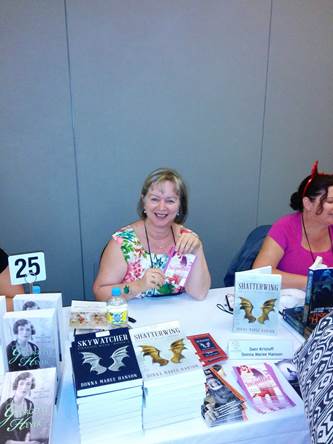
I had a fab time with Craig Cormick, Jack Heath and Dan O’Malley, strutting our stuff and signing books.

I had copies of Shatterwing and Skywatcher. Dan O’Malley had copies of The Rook. Heads up, his new book Stiletto is coming out in 2015. Craig Cormick had two books going, Shadowmaster , published by Angry Robot Books and Time Vandals, a book for younger readers. Jack Heath had a stack of books to sell, his latest Enigma amongst them. Not only is he a very talented young man (his first book, The Lab, was published when he was 18)  he’s very tall.

WE HAD A FAB TIME. THANK YOU FOR COMING. WE HAD A FAB TIME. THANK YOU FOR COMING. WE HAD A FAB TIME. THANK YOU!
Too busy chatting to pose for a photo

Too busy chatting to pose for a photo

Jack, Craig, me and Dan

Jack, Craig, me and Dan

We had lots of fun in between signing books and chatting to people. Thank you to all of you who came along.

Sharon and me

Craig, Sharon,  me and Ian McHugh

.Dymocks poster Dymocks poster

And a lovely photo of me taken by Craig Cormick, close to the end of the night. I believe I’m holding a black balloon.

Donna Maree Hanson

Donna Maree Hanson

Shatterwing and Skywatcher are available in print either online http://www.momentumbooks.com.au or Amazon stores. You can also order them in through your bookstore. Remember ebooks are available from Amazon Kindle, iBooks, Kobo, Barnes and Noble, and other eretailers.

Today I have Justin Woolley here talking about post-apocalyptic fiction, which happens to be one of my favourite topics.

Justin Woolley

Justin Woolley


The Appeal of Post-Apocalyptic Fiction

Hi readers, and thanks for hosting me on your blog Donna. Given that my debut novel A Town Called Dust is a post-apocalyptic story set in the Australian outback and we have a shared love of post-apocalyptic fiction I thought I’d talk a little about why I enjoy post-apocalyptic fiction, and why I think the genre has become so popular recently.

I think the appeal of post-apocalyptic fiction is rooted in the appeal of all fiction, overcoming conflict, and if we think about it is there any conflict as great as tearing down the world and forcing people to survive? It doesn’t matter whether the apocalypse is a natural disaster, a plague, an alien invasion or the zombie variety, in the end it symbolises great adversity that people can relate to. We all have times when we feel like our world is crumbling around us.

Of course post-apocalyptic fiction often holds a mirror up to humanity and shows us our darker side. I think that is another reason both authors and audiences love it. It’s a way to pose the question: if our civilisation is torn down around us, if the rules are gone, what do we become? Are humans little more than animals willing to kill each other to survive or will we maintain our morals, is that what defines us? Hence why, as is often the case, the cause of the apocalypse is often not as sinister as the humans that remain. A great example of this is The Walking Dead, in either the comic or the TV show the ongoing theme is that the real enemies are the other survivors, not the zombies.

You also asked me why I chose to set my post-apocalyptic story in the Australian outback. I think the answer to that is two-fold. Firstly, being Australian I wanted to set a book here simply because I know the country and while I think the book has universal appeal I also wanted something special for an Australian audience, that buzz you feel when a book is set in a place you know. Second, the Australian desert is a rich landscape and one that really invokes a feeling of vast emptiness, even lawlessness, and in many ways it already feels post-apocalyptic – just think of Mad Max the imagery of the Australian desert perfectly captures the feel of a post-apocalyptic wasteland.

 So that’s why I choose to write post-apocalyptic fiction, to explore how humanity may face the destruction of everything we know, plus zombies are awesome!

Thanks Justin. That’s great! And congratulations to Momentum for publishing another fab speculative novel.

A Town Called Dust will be released on November 13th, 2014 and is available to preorder now: http://momentumbooks.com.au/books/a-town-called-dust/

A Town Called Dust by Justin Woolley

A Town Called Dust by Justin Woolley


And here is the blurb !!   A Town Called Dust

Stranded in the desert, the last of mankind is kept safe by a large border fence, until the fence falls.

Squid is a young orphan living under the oppressive rule of his uncle in the outskirts of the Territory. Lynn is a headstrong girl with an influential father who has spent her entire life within the walled city of Alice.

When the border fence is breached, the Territory is invaded by the largest horde of undead ghouls seen in two hundred years. Squid is soon conscripted into the Diggers, the armed forces of the Territory. And after Lynn finds herself at odds with the Territory’s powerful church, she too escapes to join the Diggers.

Together Squid and Lynn form an unlikely friendship as they march to battle against the ghouls. Their journey will take them further than they ever imagined, leading them closer to discovering secrets about themselves, their world, and a conspiracy that may spell the end of the Territory as they know it.

Thank you Justin. You can find Justin on the web.

www.justinwoolley.net or follow him on Twitter: @Woollz.