Feeds:
Posts
Comments

Archive for the ‘Australian author’ Category

I’m so happy to be able to bring this interview to you. I met CS Pacat at Supanova. We were on a panel together on our early lives as writers and I was fascinated with her story and I thought you would be too. Hers was a non-traditional story and she has had amazing success. Read on!cat

Thank you so much for agreeing to be interviewed on my blog today. I think your publication story is fascinating so I wanted to share it with others.

When did you first think about being a writer and what did you do?

As long as I can remember, I wanted to write books. I took creative writing classes, but if I’m being honest, they weren’t especially helpful, particularly when it came to teaching fundamental skills like plotting or character creation. I wouldn’t necessarily recommend them for anything other than a place to meet other artists and form a support community, and a way to begin taking yourself seriously as a writer, “I commit to writing”. (A friend once described it brilliantly: In a cooking class, you are taught how to make a soufflé during the lesson. In a creative writing class you’re usually asked to make a soufflé at home without a recipe, then bring it in to class, and then everyone critiques the soufflé. But at no point does anyone ever actually teach you how to make a soufflé.)

What inspired you to write fanfic and when do you start writing original fiction?

I wrote fan fiction throughout my teens and into my early twenties, and I have an enormous respect for fandom as an artistic space. I think what drives the fanfiction writer is a desire to reclaim a text, to explore its themes, in a sense to make it your own. This can be powerful and important, particularly when those reclamations involve queering a heteronormative text, or the insertion of fantasies that until recently have not been given much expression in mainstream works, such as the power fantasies of teen girls. It’s a way of offering alternate narratives and diversifying what can sometimes feel like a narrative monoculture.

I started to write original fiction because I wanted to tell my own stories and to be able to craft the kinds of characters that I love. Captive Prince was my first complete original novel, but I did have a few false starts with original fiction before that, learning the skills that were different to fan fiction.

What made you publish for free on the web and then self-publish?

When I started to write Captive Prince there was nothing that was really like it in the mainstream commercial space. But I knew that online there was a vast community of readers and writers who were reading and creating online in part because they were seeking something that they weren’t finding on commercial bookshelves. It was also an incredibly accessible space with no barrier to entry, and so I started to write Captive Prince, and as I wrote, I posted each chapter to my fiction blog.

Captive Prince ran as a free web serial for several years before I decided to self publish the story. I did it mostly in response to requests from readers for a paperback copy of the books. It was really the support and enthusiasm of the online readership that gave me the confidence to take that step.

What did self-publishing feel like?

Equal parts rewarding and terrifying. There is a very steep learning curve, because as a self-publisher, if you want to produce a high quality book, you essentially have to teach yourself all of the skills, from typesetting to art direction to project management. You have to hire cover artists, editors and proofreaders, while learning how to use InDesign and create layouts for paperbacks, produce ebooks, and so on.

It felt scary to do at the time, but it was also incredibly empowering, because you’re learning everything you need to know about publishing, and it opens up new avenues and gives you control over your own writing.

Did big sales happen all at once or was it gradual? How much of that was due to your previous following from the web?

My online readers were incredibly enthusiastic and supportive, they wanted to buy the self published release, even having already read the free version. As a result of that, Captive Prince shot to the top of Amazon lists within a day or two of being released. It then took a few weeks for the generated word of mouth to spread and create buzz in places like Goodreads, and from there another week or two before the Captive Prince started to garner attention and reviews from mainstream review sites like Dear Author and USA Today. So, in a sense it happened in two “waves”, the first from my online readers, and a second when the book hit the mainstream market. Now that Captive Prince is being published by Penguin, it’s reaching a new audience again.

It must have been amazing to be contacted by an agent wanting to sell your work to a major publisher. Can you tell us a bit about that?

It was incredible, amazing, unbelievable. I was approached by a New York agent basically saying, “I’d like to represent you. I think we can sell your book to a big six publisher in New York.” I didn’t think it was possible but signed with her in the spirit of pure optimism. We ended up with two offers, the most robust of which was from Penguin. Now Captive Prince is being published in multiple countries and translated into multiple languages – it’s been an incredible year.

From your point of view, what are the advantages of self-publishing?

Having been through both processes, self publishing and commercial publishing, I remain a huge advocate for self publishing. I think it offers writers a way to produce a book that wholly represents their best vision of their work. You don’t have to rush or make artistic compromises due to deadlines. You can hire the designers and editors that you most want to work with, devote as much attention to your book as it needs. There are also financial advantages, in that your royalty percentage is much higher. Realistically, a commercial publisher will always be making commercial decisions, which are not always the best decisions for a book artistically.

Conversely, what are the advantages of having a major publisher behind you?

The biggest advantage of a major publisher is legitimacy. Although the perception is changing, there is still a stigma attached to self publishing. A major publisher opens so many doors, and dramatically expands the possibilities for a book, from getting it stocked in major bookstores, to garnering attention from mainstream press.

The other advantage is of course access to world class editorial, and the support of a team. I’ve worked with so many inspiring, talented people at Penguin. Allowing them to support the book frees you as the writer to just spend your time writing, which is a incredible privilege.

Do you have any advice for aspiring writers?

I have two pieces of advice. The first is that to write a book, you have to transform yourself into the person who can write that book. So I’d say figure out what is preventing you from writing, whether it is time, procrastination, or problems with plotting, or coming up with ideas, then dedicate time to solving those problems, making the changes that you need to make.

The second piece of advice is to persevere. Writing a book is difficult and there will be a long period of time where you can’t do it, your writing isn’t working, and the book just isn’t a book yet. Everyone goes through this. And everyone I know who has persevered through this stage has emerged with a manuscript, then gone on to publish it. So hang in there: it will happen.

Blurb
Damen is a warrior hero to his people, and the rightful heir to the throne of Akielos. But when his half brother seizes power, Damen is captured, stripped of his identity, and sent to serve the prince of an enemy nation as a pleasure slave.

Beautiful, manipulative, and deadly, his new master, Prince Laurent, epitomizes the worst of the court at Vere. But in the lethal political web of the Veretian court, nothing is as it seems, and when Damen finds himself caught up in a play for the throne, he must work together with Laurent to survive and save his country.

For Damen, there is just one rule: never, ever reveal his true identity. Because the one man Damen needs is the one man who has more reason to hate him than anyone else…

CS Pacat - book cover - Captive Prince

You can find out more about CS Pacat on her website http://www.cspacat.com

Read Full Post »

Perth, oh Perth, your weather was fabulous. It was an warm oasis for my Canberra ice-tinged life and you beat Sydney’s raining chill the weekend before. For a small city (in comparison to Sydney) the turnout was amazing. So many people. So many great costumes.

I arrived late Thursday night. I left work and headed to the airport. I had trouble checking in but that was because Qantas was offering me a direct flight rather than going through Melbourne. I said yes but forgot to check the seating. So I was in the middle seat, but I just finished listening to a book and watched a movie.

Friday morning, Glenda Larke texted me and I had breakfast with her and Karen Miller in the hotel. I’d been awake since 3.30am. We had a leisurely breakfast and then parted ways. Karen went to her room to write and Glenda took me shopping and sight seeing. First stop was Stefen’s Books in Shafto Lane. Stefen’s was the official book seller for Supanova this year. I was very impressed with the store and his knowledge of genre. He back orders authors’ books so the whole backlist is on the shelves. Here is Trudi Canavan’s shelf space.

Trudi Canavan Books

Trudi Canavan Books

It was a lovely day and then in the afternoon Keri Arthur arrived. We shared room and we sat and chatted to Glenda before she headed off and Keri and I got ready for the opening ceremony. This is where we authors get paraded to the audience. I think the audience is made up of the special whole weekend ticket holders and VIPs. It was a reasonably sized audience and we did our elevator pitch (with video and sound effects of a lift). The ceremony had a great vibe.

I’m not sure I did my pitch well. Lady writes grim dark, post-apocalyptic fantasy with dragons.

Dragon Wine Series

Dragon Wine Series

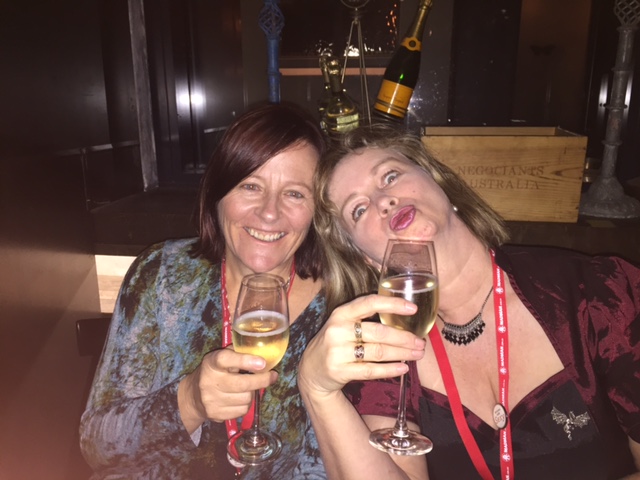
Then we searched for dinner. I was pretty hyped. This is a shot of me and Keri before I took a drink.

drinks David Henley and Wanda Wiltshire were at dinner with us. Or us with them. Or we went together. A mutual shuffling off to eat, I suppose.

David Henley

David Henley

David Henley and Wanda Wiltshire

David Henley and Wanda Wiltshire

I just realised that I don’t have a photo of CS Pecat. Oh No! She was such a wonderful person to chat to. She was sitting in the Penguin booth and sold out of books. She was so dedicated that she didn’t even get to the green room much.

Day one, Saturday, was quite awash with people. Where the author signing booth was, though, was a bit out of the way. Busy, but not standing on other people’s toes crowded. It meant we got good views of some costumes. These lovely ladies came by. I guessed they were the twins from The Shining. I’m so proud of me.

#Itsatwinthing

#Itsatwinthing

These ladies hand sewed these. They also got a shot in our hotel corridor that it looked like a shot from the movie.

Saturday night we had the VIP party. Great venue. Larger and more spread out than the Sydney venue. You could have a conversation at least. Keri and I were holed in a corner and then later on we discovered the other authors and we joined them. By then I had too much to drink. I’m a cheap drunk but apparently my conversation was interesting! We figured that the VIPs come for the actors and other celebrities, but we did have our own author fan.

At the bar I chatted to some of the guests. Here, I learned that many of the guests played Cards Against Humanity at night. Apparently, some of the actors played in character. So I have to use my imagination to think how Bender sounded playing Cards Against Humanity. They also had the expansion pack. Awesome. I would have loved to have joined them.I love that game. I was a bit shy to do so on the Sunday.

Keri thought my hangover was hilarious. I had a sinus/cold thing happening at the same time so I felt especially crap. I shuffled and groaned like a zombie to the loo in the middle of the night and then again and again. Lucky the authors are good at exchanging vitamins and meds. I had bacon as my hangover remedy. As the day progressed Keri has less to laugh about as I normalised.

baconSurprisingly, Sunday was much busier than Saturday for us in the author booth. Wanda had a fan who couldn’t find her. Wanda was doing people’s fairy names and colours and he wanted to do  his. During dinner the previous night she had given him directions via Twitter. He said ‘I’m blind and dressed as a dragon.’ When he turned up we were so happy to see him and his guide. He was an awesome green dragon.

Green dragon

Green dragon

The twins came back in new costumes (handmade).

#itsatwinthing

#itsatwinthing

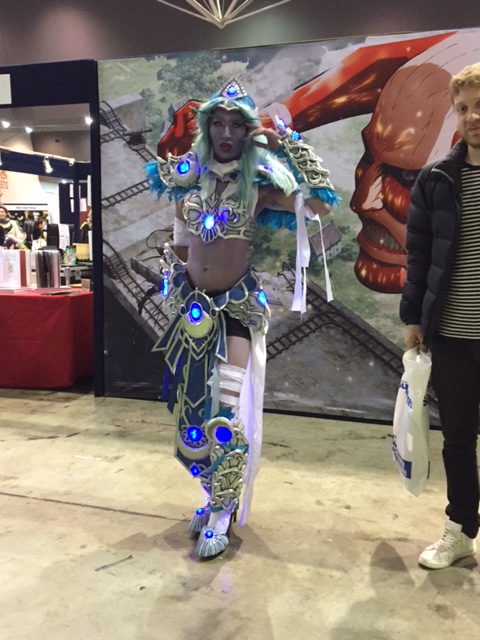
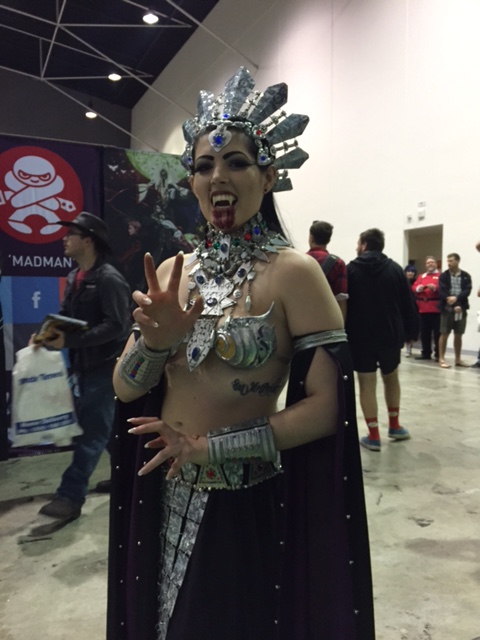
Lots of cosplay. Some we got shots of.

queen of the damedAnd the Queen of the Dammed from Anne Rice

Queen of the DammedSad we had to say goodbye. There was an author dinner with the lovely Ineke, Kevin Hearne and family, Kevin J Anderson and Rebecca Moestat and we didn’t get photos! Shame. Apparently there was an official author shot in the Green Room but I missed it.

I did get a shot of Keri and I feeling exhausted.

Keri Arthur and Donna Hanson

Keri Arthur and Donna Hanson

But really we looked like this.

Keri Arthur and Donna Hanson

Keri Arthur and Donna Hanson

Luckily I was still in Perth for Monday so I was able to slowly wind down from all the hype and excitement. It was a hard withdrawal, but I had Keri to help. She is an excellent person, a wonderful roomy and an inspiration in so many ways. I heart her!

Many of the guests went off to Freemantle on Monday. Keri and I went shopping. (shopping with Keri is a dangerous sport).  I bought stuff, but the most excellent thing I bought this leather jacket. ( I will own that I did not intend to buy this jacket. I will also own I had to do some bank gymnastics to effect the purchase but that I don’t regret it. It’s lovely and will last forever). (BTW you can tell I’m in denial.)

Retail Haul

Retail Haul

So that was my Supanova put very simply. It was hard not be dazzled by the other guests, about being a guest myself. But I’m back in to real life now and I will file it away under great experience.

Read Full Post »

Thank you for coming along to the blog today, Thoraiya and congratulations on your wonderful book deal with Tor US. I am so excited for you and as you know I’ve been a fan of your work for more than 10 years! I hope you will visit again when your book is coming out so we can share the blurb and the cover and all that other wonderful stuff that happens when a book gets published.

Thanks for having me, and yes, please!
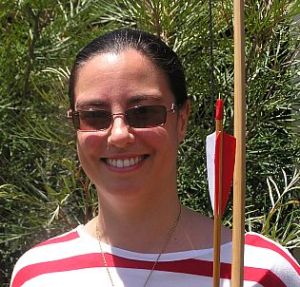
Thoraiya Dyer

Thoraiya Dyer

Can you tell us a bit about the book (series) that is going to be published?

Sure! Today I found the bit of scrap paper I first wrote the idea on. It reads: “Write an epic fantasy novel about a tropical rainforest where countries are not horizontal, but vertical, and defended by magic.”

Even though I planned TITAN’S FOREST as a standalone initially, CROSSROADS OF CANOPY still fits that basic description. A pantheon of reincarnated gods and some mythically reimagined Australian fauna and flora made its way in there, too. Unar, protagonist of Book #1, is a Gardener – a sort of apprentice priestess – in Canopy, the vast and leafy jungle city where the rich and privileged leave tributes at temples and get fat on sun-ripened fruit. In Canopy, they’re safe from demons that lurk below their deity-maintained barrier, and they generally have no idea where their excrement goes when it falls down into the dark.

But Unar’s sister falls down there, and that kicks off her adventures.

Excellent! I guess I should explore your writing history. How long have you been writing? What did you start on, novels or short stories? What are your bread and butter (that you like the most?)

I started pounding out the requisite million unpublished words in high school! Novels first, even though later, when I was working full time and doing after-hours calls, it took almost 5 years to write just one. Then, when I was pregnant I had lower back pain and couldn’t sit at my computer for very long to type. That’s when I wrote “Night Heron’s Curse”, which was my first published short story. Tehani Wessely bought it for ASIM in 2008. Also in 2008, I attended a workshop with Jim Frenkel at the Brisbane Writer’s Festival, and he advised me to build a reputation with short stories before I wrote another novel. I like both. I don’t think I’ll stop writing short stories.

It’s taken a long time to get this far, hasn’t it? The industry seems to be getting more and more difficult to penetrate. Can you tell us a bit about how you got an agent and then the book deal?

It has taken a long time, and I’m glad I was oblivious, early on, to how much work and persistence it would take, because I might have given up. On our first day of lectures at vet school, which I’d worked my ass off to get into because I wanted to be a zoo vet, I remember hearing the recommendation that zoo vets get a decade of experience with cows, first. It made sense. Giraffes, rhinos, elephants; the closest you’re going to get to them in private practice is cattle.

But I was devastated! I thought there was no way I could survive ten years of getting smooshed against fences by poo-covered cows, all for a tiny chance of gaining one of the three zoo vet jobs in all of Australia that would only be vacated when one of the existing zoo vets died. And those people all seemed young and healthy!

So, I was discouraged. I decided to be a small animal vet and just do whatever bird and wildlife work I could get on the side. That’s why I don’t like it when people ask me how to get published, because “write stuff that isn’t good enough for ten or twenty years” is a horrible, discouraging answer, and I would have hated anyone who told it to me when I was in high school!

I got my agent, Evan Gregory, by querying according to the agency guidelines. I hadn’t met him at a fancy overseas convention or anything glam like that, haha. I was a Locus subscriber. Every time an issue came out, I’d open to the ‘BOOKS SOLD’ section and highlight all the agents that represented work that sounded like mine, and that’s how I’d make my list of who to query. It helped that Evan had an interesting blog, and worked for Ethan Ellenberg, who reps John Scalzi and Karen Miller. Both authors had spoken highly of the agency so I knew they weren’t dodgy.

The book deal came about, I guess, because Evan does go to conventions, and fancy lunches (maybe they aren’t that fancy, maybe they eat discounted sumo salad on park benches?) – ANYWAY, the point is, he had a better idea than me who the editors were that might be a good match for my work. And he was right, wasn’t he? And simultaneous submissions are brilliant compared to my decade of sending printed novel manuscripts in the post to one publisher at a time and then waiting years for each reply.

And I was over the moon after the offer from Diana Pho at Tor. She is just lovely. I’m thrilled to be working with her. Tor was the first publishing imprint for grown-ups I ever really became aware of, plundering the Eye of the World from Mum’s shelf and inhabiting the world of the Wheel of Time in my school holidays.

That is persistence! I’m happy you had such a wonderful outcome after so much hard work. You have written a number of works and have had recognition for many short stories over the years? Did the award wins help you gain notice from publishers? Did you find short story writing honed your novel writing skills or was it unrelated?

I have no idea if the award wins helped me gain notice. The invitations to contribute to anthologies that I occasionally received could have been because of awards, or just because the editors had read my stuff. They sure gave me confidence and hope for the future. And the Aurealis and Ditmar award ceremonies brought me to my first conventions and introduced me to the community. I first met you in person at an Aurealis night, didn’t I? I love the community! Hello, community!

It sure helped to know that my writing, sentence by sentence, was publishable and that people enjoyed reading it. But I think, for me, short-story writing might have been a pleasant detour instead of a necessary phase. If I had to guess at the weaknesses of my early manuscripts, I would say problems with novel-length structure and novel-length character arcs, and I couldn’t learn those from writing short stories. My strength has, I think, always been pretty writing, and yeah, the short story words I wrote might have gotten prettier, and they certainly got more succinct, but I suspect that wasn’t what was keeping my novels from being bought.

I know how you feel! How did you keep up your motivation all these years? Do you have any advice for other writers who are struggling to maintain the faith and keep writing?

Living in denial? I did this thing where, in order to be excited about the book I was writing and make it the best it could possibly be, I had to believe it was The One. No matter how many stats or experts told me my first book might not be The One, and my second book might not be The One, and my third, and my fourth, I had to tell myself they were wrong, and that THIS one was The One. Every year, my New Year’s resolution was to write better, to write The One.

Which automatically meant I couldn’t be the arbiter of which one really was The One, which is why self-publishing could never be for me. I knew I would have to keep throwing novels at the trad publishing wall until one stuck. Kevin J Anderson’s popcorn theory (Google it!) worked for short stories, so I had to believe it would work for novels, too.

It’s not easy. To willingly, deliberately delude yourself that you’re an exception to the rule (where failure is the rule, the statistical likelihood anyway); to rely on long-suffering editors to bring you back down to earth by telling you not yet, not this piece, not this market; to wonder if you’re suffering from that syndrome where the more incompetent you are, the more likely you are to think you are competent, etc.

To read other people’s stories, not knowing if your story is the one where the writer persists and finally breaks through, or if yours is the one about the ex-writer who walks away and becomes a teacher or a truck-driver and lives a happy life with enough money to buy plenty of books.

If you are reading this story, my story, I’m sorry that I can’t tell you what your ending is going to be. I can only tell you that I cried harder at the thought of being forced to give up out of financial necessity than I did over all the rejections pouring in (happy face!).

Did you have to make sacrifices to continue to write (personal , physical or material)?

Yes.

Chiefly material sacrifices. My husband is amazing and my kid is brilliant, my parents do what they can and my friends are the best; I feel personally supported in every way. But 2014 was still horrific. There was kind of a slow creep, a reduction in living standards, starting with me leaving my job as a vet to have the Small One, culminating in some stark financial realities as I decided to try and make this writing thing pay off instead of going back to veterinary practice. It was a shock to my self-image, going from being a person with a successful, professional veterinary career, with a home and an investment property, to a person with none of those things – and I was panicking until two months ago about keeping my little car. Now I have a book advance coming and can breathe a little easier. Of course, I can’t be sure how much of all that was my career change, how much our move to an expensive area, how much was motherhood and how much bad luck. But, hooray, this seems like a luckier year!

If you could give three tips on writing and writing well, what would they be?

Devour other people’s books. Write when you are inspired and also when you are not inspired. Don’t rewrite until you get to the end. (There, now you’ve made me give shit advice already, because that works for me but not everyone).

Look, I can only think of those two things that apply to everyone, and I’m not even sure about that second one. OK, what about read good blogs? Like this one! And the Book View Cafe blog. Maybe Chuck Wendig’s place, and NK Jemisin’s. Ian McHugh’s blog, and Pub Rants, and Man Versus Bear. Cat Valente’s archived posts are still good, even if she doesn’t blog as much these days. And Sean the Bookonaut and Ebon Shores can give that sense of community. Take the advice from them that seems most useful to you. And practice. Keep practicing.

What were the instances in your life that inspired you to keep writing (besides award recognition)?

Travelling to beautiful places. Discovering amazing things. They have always inspired me.

I started writing CROSSROADS OF CANOPY after a trip to Cairns and the rainforests up there in tropical Queensland. All the other rainforests I’d been to wanted to come to the party as well – Nepalese forests, Canadian ones, Tasmanian and Singaporean and New Zealander. I put my version of the Hanging Gardens of Babylon in there because of a book on ancient civilisations that my Dad brought back from Lebanon for me.

It was pretty inspiring at Worldcon in Melbourne when random strangers asked me when my first novel was coming out (I still don’t know exactly!). Also, quite surreal.

One recent inspired moment was when my husband and I stood outside the dusty, desolate storage facility we’d hired. All our beautiful furniture was inside, some of it hand-made by him from gorgeous Australian hardwoods; furniture we couldn’t fit in the rented unit where we were going. I saw my veterinary textbooks in boxes next to my favourite fat fantasy novels, and asked him in a very small voice if I should keep the veterinary books out, because maybe the writer-dream was over, and he said, with complete confidence, without hesitation, that I would not be needing them.

Looking back, where did you gain your personal leap forwards with respect to your writing? (such as perseverance, feedback, an editor, insight gained over years?)

The most serious problem with the Self-Delusion Method is that you spend so much time convincing yourself that everyone is wrong about your writing not being awesome that hearing criticism without getting defensive can prove difficult. That’s even before you learn that two people will give completely opposite feedback to each other. And sometimes the feedback is wrong. When you’re new, you’ve got no idea when it is and it isn’t wrong, so you might try and work it out scientifically – that is, to get many people commenting on one piece, so it’s more like a survey. But then different people will have different areas of expertise, so your survey is weighted, and then it’s not really a survey any more, is it?

I regret the times I’ve been ungrateful about feedback. The Self-Delusion Method should probably be stricken from the list of advisable routes to publication. One moment that led to a bit of a leap was when Alisa Krasnostein at Twelfth Planet Press took most of the pirate-talk out of my pirate novella in the name of improving readability and I was convinced she was wrong – SO WRONG! – but I went along with it, grumbling inside. I was so immersed in pirate slang at that point I had lost all perspective on what a normal person would or wouldn’t understand from it. And then about a year after it was published, I sat down and read it again, after I’d lost my sea legs, after I’d lost the pirate cadence from my inner voice, and saw how she had been right – SO RIGHT!

Trusting the most excellent editors that I’ve been fortunate enough to have was probably a bigger step for me than it should have been (happy face!).

Wow. Thank you Thoraiya. All writers have personal journeys to continue writing, but yours is truly inspiring. I have made some material sacrifices but not any where near what you have done. I am so pleased for your success. Seeing you succeed should give other aspiring writers hope that their turn will come. I wish you every success and I’ll see you back here when the book is coming out.

HUGS!

Read Full Post »
I’ve known a new cover was coming but nothing could prepare me for the awesomeness of it.

Here is the resdesigned cover of Rayessa and the Space Pirates.

Rayessa And The Space PiratesIt’s so very cool.

Also, I’m not sure if I shared the blurb of Rae and Essa Space Adventures.

In Rayessa and the Space Pirates, Rae made a startling discovery about her past. Now her twin sister Essa has her own adventures to pursue.

Essa Gayens is starting to accept her sister Rae into her life, sharing a dorm room in their swanky private school on Earth. Smarter, savvier and more in touch with the world than Rae, Essa’s feelings of superiority and advantage are shaken when their mother goes missing, along with Rae’s boyfriend, Alwin.

When Rae takes off after them into outer space, Essa is spurred into action. Very soon, Essa is hot on her trail, sneaking out of school, bribing officials and begging Captain Thorn Hanover to take her on his ship.

Thorn is a hunk, and Essa is thrilled with the prospect of an interesting trip, but Thorn has no interest in a spoiled rich girl. Not only does he reject her advances, he sets her up on the chore roster and expects her to work for her passage.

Essa has never been anything but a pampered princess, but both Rae and Thorn are challenging her to dig deeper, to be more. But to aspire is to risk failure, and Essa has never really risked anything before. Can she start with her heart?

I also noticed that iBooks had Rae and Essa Space Adventures for 99 cents.

Here is a link the Australian iBooks store. Link.

Read Full Post »

Being a writer isn’t only about the writing of books and stories. There is this thing called “PROMOTION” which has to be done.  Except it’s not promotion per se, it is letting people know you exist and then maybe that you write as well. Sometimes that is fun and sometimes it’s hard work. Sometimes you don’t even know if it’s doing you any good.

I love Twitter! Thank God for that. It makes my promotion life easier, but I just like hanging and keeping up to date. I’m probably a wee bit, just a teeny eensy bit over stimulated, particularly for my age group. My grown up kids don’t use Twitter like I do and definitely don’t get it.

Facebook is cool too because it’s so useful to keep in touch with people and extended family and it has some fab tools, like pages. Of course, playing around on Facebook is time consuming too. I’m probably lucky that I can justify the time spent on their as promotion, when is just another form of procrastination.

Blog posts (like this one) take time to write. Not only do I need to maintain this blog, but I should do guest blogs and interviews to get my name out there. This are great but boy can they be hard work. Interviews are pretty easy really except where there are hard questions. The hard part of these is not letting on you’re an idiot. Okay, okay.  I mean sounding like an idiot. Also, you want to let some of your personality through, preferably not all of it. Not the I had ‘one margarita too many’ personality that only your dearest friends have seen and have refrained from putting the footage of such incidents on Youtube. Then there are topic based blog posts for other people’s blogs. I think I spend as much time staring at the screen thinking up what I will talk about as I do writing the post.

Then we come to what do I write on my blog to keep it active, so people know I’m alive and also I’m not writing posts that say ‘buy my book, buy  it now’ every day. To help with that I do interviews on various topics. Usually these are related to the craft of writing and it gives other authors an opportunity to promote their work as well as sharing their writing titbits. I suppose some smart and hyper-intelligent person is thinking, why are they doing this? In the good ol’ days writers didn’t do this. They just wrote.

I’m sure many a writer has thought the same and doesn’t bother. Unfortunately, these aren’t the good ol’ days anymore (that’s why the are called the good ol’ days). We are a very connected society. There’s the Internet and there’s Internet shopping. There is also fewer physical bookstores to put books in for people to buy by walking past it on the shelf. That does go on still, but not in a big way.

Then there’s ebooks! They aren’t on physical book shelves. They are on the Internet so the Internet is where you need to market those. Discoverability is the new challenge. It’s always been a challenge I believe, it’s just harder these days. There are a lot of writers out there. Writers are in competition with games, dvds, social media and other forms of entertainment.

Speaking of YouTube, I have not got very far with that. There could be live blogs, interviews, panel discussions, book trailers, pictures of me sunbathing and other things that I can’t think of right now. Working full time with my day job leaves me with plenty of imagination but little time to invest in putting ideas into action.

Now we come to the point of this blog post. You have probably been wondering that.

Doing this for two is a killer. I have two of me!

There’s me and there’s the other me. That’s two lots of blogs, Twitter, Facebook and guest blogging to maintain. It’s like having your brain ripped out through your nose. Okay that’s mummification! But you know it’s painful. I have to think stuff up twice! TWICE!

I shouldn’t complain. I mean I decided to have two of me, writing completely different stuff so I should have to wear it.

Why am I telling you this? If you think I’m not doing a good job keeping my blogs up to date, then this is my letter to the teacher.

PS I tell a lie. Rayessa and the Space Pirates also has a social media presence. That’s three.

The non-official photo of me

The non-official photo of me

Photo by Taamati Terata

Read Full Post »

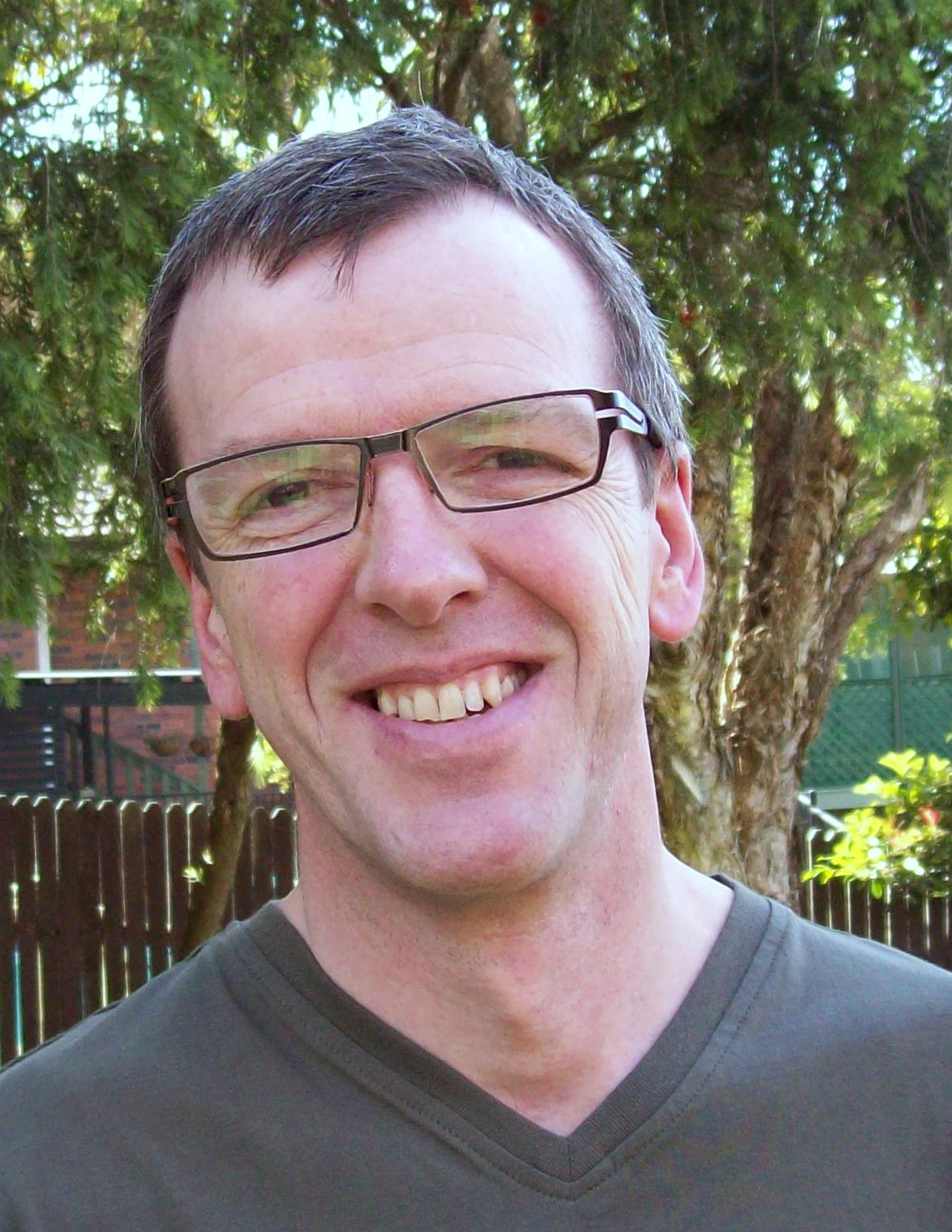
I’m very lucky to have Keith Stevenson visiting the blog today to talk about writing and his science fiction novel, Horizon.

keith_stevenson_colour_hi_res

Can you tell us a bit about your new novel?

Horizon is a science fiction thriller, where personal and political differences between a small group of space explorers play out in the cramped confines of a starship far from Earth, with repercussions for the future survival of the rest of humanity. I wanted to write something that set believable characters, with their own fears, weaknesses and biases, in an extraordinary situation while addressing the key issue of our time: climate change, how we respond – or fail to respond – to it and what that means for our future. It also has quite a bit of cool science about travelling through space and exploring new planets, but at its heart it’s an adventure story.

Keith can tell us a bit about yourself?

Well I’m originally from Scotland, but settled in Australia in 1989 and now live in Wollongong. I’ve been fortunate to be involved in some really cool projects, firstly as submissions manager and later editor of Aurealis Magazine, and organising convenor of the Aurealis Awards when they were still in their relative infancy; then founding my own publishing company coeur de lion with fellow author Andrew Macrae, publishing a lot of excellent Australian spec fic authors (and picking up more than a few awards); running the Terra Incognita speculative fiction podcast which featured the best Australian speculative fiction read by the authors who created it; and most recently launching Dimension6 the free and DRM-free electronic spec fic magazine.

All through that time, and even before, I’ve always been writing. I actually started writing horror stories for a class magazine in primary school. I’m a really slow writer, so I’ve only had a handful of short stories published in Aurealis Magazine, Agog! Fantastic Fiction, and ASIM. And Horizon took a lot of time to come together.

Tell us a bit about why you are write SF?

I love he hopefulness of science fiction, even when it’s SF where bad stuff happens, because at the very least it posits a future where humanity still survives. When I was a kid I read in a junior encyclopaedia that the sun would eventually swell up and destroy the Earth, killing everyone on the planet. That really upset me, regardless of the fact that fate was billions of years in the future. It was pretty soon after I discovered science fiction and realised that was our escape plan – the future imagined by SF writers is a future that has to come about in order to save us all.

Later as I read more and more, I understood that SF was also an ideal way to dissect and interrogate the present, magnifying trends or playing out ‘what ifs’ to demonstrate the underlying truth of the world around us. And it’s a genre that lends itself easily to amazing, adventurous stories. It’s an incredibly powerful and underrated genre. There should be more of it.

I understand that you have been working on this novel [for a long time?]. What kept you going back to this story?

First novels are pretty daunting. I was lucky because Horizon was my ‘project novel’ while I was studying Professional Writing Course, so my approach was very structured. I had to write a proposal for my tutor, exploring the ideas and forms I wanted to portray, and a detailed chapter by chapter synopsis, and then turn in 3,000 words every fortnight for group critting. By the end of it, I had 60,000 words of fairly robust text, which was a big leg up to getting the thing finished. Of course it still took a long time to finish, but I had developed the characters so much that I wanted to see how it all panned out for them, and how believable I could make the whole story. It’s the same with the space opera I’m writing, which I talk a little more about below. Those books have taken me years, but I have to go back to finish the story because I owe it to my protagonist. I’ve made a promise that I won’t leave him high and dry. But I’m also just enjoying writing a massive adventure.

Can you tell us a bit about what’s coming next (is there a sequel)?

Horizon was always envisaged as a standalone. There’s room for a prequel based on the events on Earth as well as a sequel, but I like the story as it is. The crew learn what’s happened on Earth while they’ve been in hibernation and the book ends with a very neat jumping off point that leaves the reader to imagine what might happen next. My focus was on the character interplay as part of the present action and how they deal with the dangers and threats that face them.

What are you working on at the moment?

Aha, well this is another long term project.  The Lenticular Series trilogy is a huge galaxy-spanning space opera with lots of alien species, space battles etc., which will hopefully see the light of day in a couple of years. It has at its core a really strong character study of a person (alien actually) who loses everything, achieves some sort of redemption but almost destroys himself in the process. That’s really given me a solid backbone to build lots of action and intrigue around and I’m really enjoying writing on such a big canvas.

What is your writing process? (planner, panster, write every day, write sporadically, writers block etc).

I map out key plot beats, where I know characters will end up at point A, B, C on the storyline and then I tend to just write towards that beat. I prefer to write longhand for the first draft, because it really slows me down to think about the action as it’s unfolding. It also lets me follow impulses (and maybe stray off the main throughline to explore and develop related ideas). That’s allowed me to build in whole side plots I hadn’t considered in the planning stage. I pretty much go at that day in day out until I’ve written through to the end point – which may not be the end point I envisaged at the start. After that it’s into the rewrite phase, interrogating what I’ve written and trying to coalesce it and also look for missed opportunities, things that are not working, or aren’t fresh enough and so on. At some point I’ll sub the ms to Serapeum, which is a group of Australian writers who meet every year or so and is solely focused on novel development. If I please those guys, I know I’m on the right track. Then it’s more rewrites until I think it’s ready – to be put through the wringer by an editor, that is!

I’ve never encountered writer’s block. I tend to stop writing in the middle of a scene, so I know where to pick things up the next day. Richard Harland does something similar and he’s never been afflicted with it either.

What do you prefer drafting the story or revising and reworking?

I really like the discovery of first drafts. It’s almost dreamlike the way lines of dialogue float onto the page. But I also love the invention of revising, when you’ve just read something you wrote a while back and it suddenly falls into place with something else, creating possibilities you hadn’t considered before.

What part of writing do you find hardest?

Making it right. Work can always be improved and at some point you have to trust someone else – an editor – to help you do that. A fresh set of eyes really makes a difference and I am very much in awe of what a really good trade editor can do across a whole spectrum of things from making ideas gel better to really making the language sing. Authors are often too close to their work to do that for themselves.

What do you plan to work on next?

Well I need to redraft book 2 of The Lenticular and then start on drafting book 3. That will keep my busy for a long while, I suspect. After that I have an urban thriller I worked on as a screenplay with Paul Haines many years back. I’d love to dust that off and see if it can be turned into a novel.

Thank you, Keith. Those are some very insightful and indepth answers. Here is the book cover image and the blurb.

Horizon book cover

Horizon book cover

Thirty-four light years from Earth, the explorer ship Magellan is nearing its objective – the Iota Persei system. But when ship commander Cait Dyson wakes from deepsleep, she finds her co-pilot dead and the ship’s AI unresponsive. Cait works with the rest of her multinational crew to regain control of the ship, until they learn that Earth is facing total environmental collapse and their mission must change if humanity is to survive.

As tensions rise and personal and political agendas play out in the ship’s cramped confines, the crew finally reach the planet Horizon, where everything they know will be challenged.

____________________________________________

“Refreshingly plausible, politically savvy, and full of surprises, Horizon takes you on a harrowing thrill-ride through the depths of space and the darkness of the human heart.” – Sean Williams, New York Times bestselling author of the Astropolis and Twinmaker series

“Crackling science fiction with gorgeous trans-human and cybernetic trimmings. Keith Stevenson’s debut novel soars.” – Marianne De Pierres, award-winning author of the Parrish Plessis, Sentients of Orion and Peacemaker series
You can say hi to Keith on Twitter and Facebook and on his blog.

https://www.facebook.com/keithstevensonwriter

@stevenson_Keith

Read Full Post »

« Newer Posts