Feeds:
Posts
Comments

Archive for the ‘Uncategorized’ Category

Lee Harris on editing

As a continuation of this series of blog interviews with editors, I am happy to introduce Lee Harris, who is an editor with Angry Robot. He edits novels, exclusively. In previous roles, he has edited  short fiction and also headed up Hub Magazine. Angry Robot Books can be found here.

I am very grateful that Lee (and Ellen) could spare the time to answer these questions for this blog. More interviews will be going up over the next week or so.

Why did you become an editor?

LH: I started off editing short fiction when I founded the (then print) magazine, Hub, as I was fascinated by the editorial process, and always hoped I’d be good at it. When Hub became electronic-only, and weekly, I was invited to apply for an editorial role with Angry Robot – this was some 9 months or so before we launched. Gradually my editorial duties with Hub decreased as Angry Robot launched and grew.

I couldn’t possibly hope to add much to Ellen Datlow’s article on editing short fiction – she’s one of the best short fiction editors we’ve ever had – so I’ll focus my answers on novels.

What is the most important aspect of your editing role?

LH: Finding and nurturing new talent, and helping my authors to make their manuscripts the best they can be. Editors are ideally placed to see the whole shape of a novel, and to advise an author, accordingly.

Which areas of editing to you find the most enjoyable?

LH: Every stage holds something to keep my interest and enthusiasm. I particularly enjoy finishing the novel for the first time, and letting its shape sink in, working out which sections need particular attention, and devising some suggestions for the author.

In your view can editing be taught?

LH: A difficult one, this. I agree with Ellen Datlow to a large extent, when she says it can’t be taught, but I’d qualify that. I think it can be taught, if the student already knows how to do it. It’s a largely intuitive process, that is self-taught over many years (usually without conscious effort) through the process of reading. A lot. It’s self-taught through osmosis. A course can’t teach this – only time and dedication to the written word can – but a course can help highlight the things you already know, but perhaps didn’t realize that you already know. A course can be a great source of confirmation in the editor’s ability. I doubt that many publishers would be swayed by a candidate who attended an editorial course, but if that course serves to provide the would-be editor with an increased confidence, then it’s served a purpose.

Copyediting and proofreading can be taught, of course, though even here, an editorial eye to style is needed. There is absolutely nothing wrong with an author breaking the rules of grammar and punctuation, but they should know the rules before they break them. Similarly, a copyeditor should know how to spot the difference between a mistake and a stylistic choice.

How do you define the editing role?

LH: The editing role as opposed to process? The editing role encompasses more than just the editing of the work (the process). An editor’s is to find (or commission) the books they want, to champion the work internally (to sales and marketing) and externally (alongside sales and marketing), and to ease the work along each stage of publication, working with artists, designers, copyeditors (which my word processor has just auto-corrected to “coy editors” – they’re usually not!), proofreaders, typesetters, marketers and, of course, the author.

Mechanics of editing

LH: Editors work in different ways, but toward the same goal – to help the author find a way to make the manuscript as good as it can be. I’ll cover the structural edit, here. At this stage the editor looks at the shape of the novel, and might conclude that – for instance – too many characters are introduced too soon, or the fountain scene in chapter seventeen would make more of an impact if it were moved to chapter four, or that the protagonist performs an action out of character in order to service the plot, or that character X is less well-defined than she could be. The editor should never meddle, though, but merely make suggestions for the author to improve their already-excellent-if-not-quite-ready work. The editor suggests ways to improve the shape, but the authors is always the one with their hands on the clay.

What areas of editing do you find most challenging?

LH: Time management is the big challenge for me. I naturally find it more rewarding to focus my efforts on the shiny thing in the corner – to work on the parts of the job that I particularly  enjoy. It’s easy to conveniently forget to update the database with revised page counts, or to rewrite a book blurb for the twelfth time because a particular business partner needs it in a specific format. I find electronic To-Do lists a great tool to help me manage my time, and to tell me what I must be doing when instead I’m doing what I feel like doing.

Do you have any advice to aspiring editors?

LH: Make your own luck. Determine your strengths (it will take time). Join a local writers group and offer to critique and make suggestions on their manuscripts. Volunteer with an online fiction group. Organise your own group (online, in a quiet pub, at someone’s home). Make your own luck.

Thanks Lee for these insights. I really must get into that electronic To-Do lists!
Read Full Post »

It’s called Grammar Girl-Quick and Dirty Tips and it is great. Simple and really, really useful.

Try it here.

Sometimes I do a quick dip and others I spend quite a bit of time looking through the questions and answers. Apparently the author of the site does blog posts and has a book too.

Go forth and grammar-fy your work.

Read Full Post »

Some of you may have heard that Colin Harvey passed away suddenly last week. He was more recently published by Angry Robot. I had the pleasure of meeting Colin at Anticipation, the World Science Fiction Convention in Montreal, Canada, in 2009. His book Wintersong was launched there, along with the imprint and the books of my friend, Kaaron Warren and Lauren Beukes. I recall also Andy Remic’s Kell’s Legend may have featured at the launch.

Sometimes you meet someone and they touch you in a way you remember and cherish. Colin was one of these people for me. I didn’t know him well, but I managed to keep in random contact via Facebook and Twitter and he came to have dinner with us when we were in Bath last year.I was very impressed because he caught a bus. We also caught up with him in Bristol, when the lovely Cheryl Morgan organised for us to attend the William Gibson talk.

He was cheerful, gracious, supportive and a lovely man. He was a talented writer. In our talk over dinner and wine last year, we learned a bit more about Colin. Mostly it was that he was happy and doing what he loved. (and surviving on a low income doing what he loved)  He was published with Angry Robot and had another book out, Damaged Time. He had retired from work some time before and was studying creative writing. He was editing an anthology, Dark Spires, with Cheryl Morgan and he lived with his wife Kate.

I read Wintersong after worldcon and wrote a review of it on my livejournal blog.

Here is the text of it:

Winter Song is an sf novel published by the new Harper Collins imprint Angry Robot.

Karl Allman lives in a post human world. His body is augmented by nanophytes and he can interface with artificial intelligence. Its a galaxy where humans terraform other worlds to make new colonies and where there are factions and wars. Karl’s ship is attacked and he crashes to the iceworld of Ishiemur, a failed terraformed planet, inhabited by Icelandic colonists. That Karl survives his spectacular landing is the first amazing thing, then that he survives his injuries is another.

Bera, a young girl, mourning the loss of her new born child, tends to Allman as he recovers. Living in a small community, her pregnancy, has drawn criticism and scorn from the other women in the settlement and her foster father, Ragnar. Icelandic traditions, culture and legends loom large in this colony and as it has been isolated for long in has devolved as well and technology is rudimentary. Scarcity of food and resources is a fact of life for the colonists. Most of the flora and fauna are toxic to humans and Allman is required to work off his debt, the food and care he received while recuperating. For some reason, Allman alternates between being rational and being another person, who the locals name Loki. He is either mad or a seer. It soon becomes apparent that Ragnar is not ever going to be happy with repayment and Allman has to make a choice to escape and send an SOS.

What follows is Allman and Bera’s journey across this harsh world to find a way to send a signal. Ragnar will not relent and the chase is on.

Winter Song is a fairly fast and satisfying read. Allman’s plight and Bera’s drew me in and I found I was fascinated with the relationships Bera manages in her claustrophobic community. As the story unfolds, Bera comes to terms with rape and I think Colin handles the feminist themes here quite well and sensitively. There are things that Bera would like to do and cannot because she is female in a strongly patriarchal society. She is also an intelligent and sensitive character that hides a secret to keep the peace and in doing so injures herself. Winter Song is the story of how Bera finds herself and learns to love. In this sense, Allman is an agent for change. He crashes into the planet and into the lives of the Isheimuri people and that change expands like a snowball rolling down a hill. In some ways, Allman is too indestructible and that can lessen the impact of his suffering and need.

Not all the threads of the story are tied together by the end. Trolls are examined and analysed in a satisfying way, but the legendary shapeshifters disappear from the narrative. Ragmar undergoes a change after much carnage. Yet I think it is Bera that has been most affected.

The Icelandic setting added a layer of fantasy-like dressing, horses, sword fighting and legends and gods and the cultural layers also represent as authentic. I felt that Colin had done his research. The prose style was strong and didn’t draw attention to itself and there was the occasional nice turn of phrase.

I bought Damaged Time and will read it now.


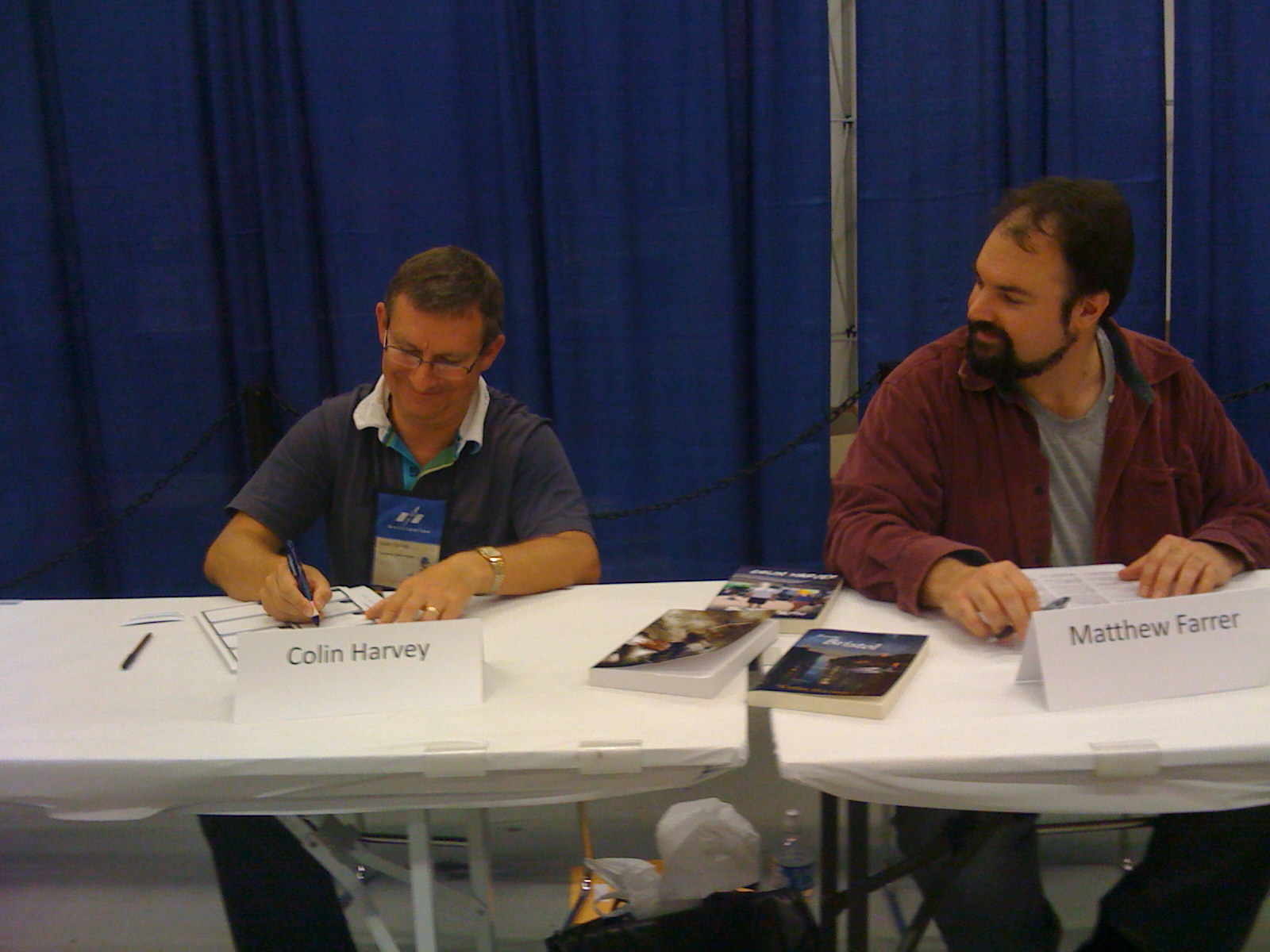
Here are some photos from that fantastic convention in Montreal. Colin with my partner, Matthew Farrer at the book signing table.

Colin and Matthew booksigning

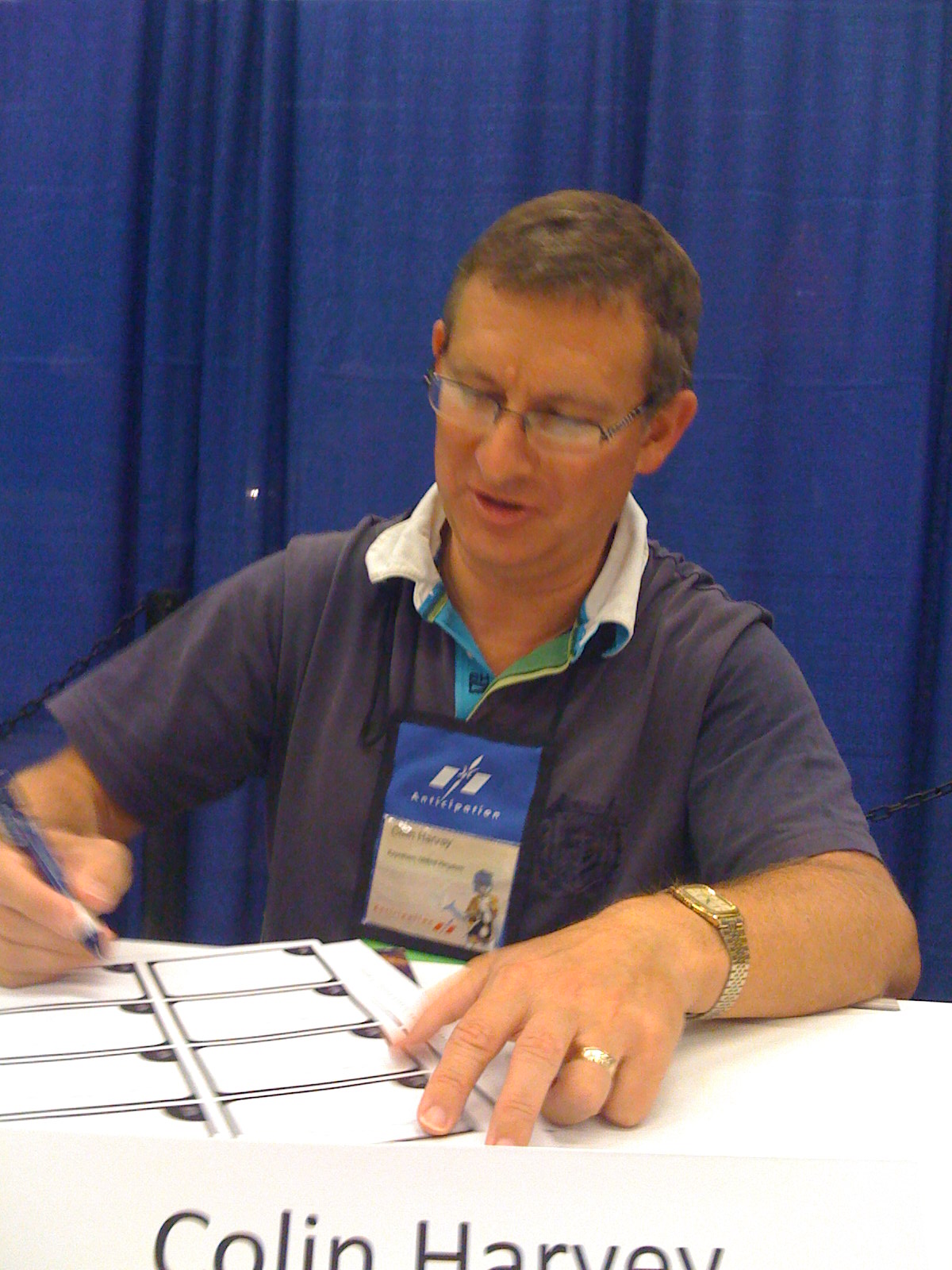
Here is one of Colin, signing book plates. As his book had only just launched there weren’t many people lining up.

Colin signing

And one last one with Lee Harris, Editor, Angry Robot Books.

I’ll remember you Colin. Rest in peace.

Colin and Lee

Read Full Post »

With regard to reading for Angry Robot Books, I am half way through the second last MS and will probably start the last one tomorrow and finish it sometime over the weekend. Today I sent out a few rejections and a couple of good news emails on further recommendations to Angry Robot Books. These two shift the gender balance further as both are male. That is 14 recommended manuscripts for the editors. I’m not sure whether they hate me or love me for sending so many. I’ll be asking for feedback from them eventually.

After reading the last of the MSs, I have to trawl through my submissions table (running at about 10,000 words) to find the names of those I said I’d recommend to the editors. I’m not sure how many of these there were-probably a handful. By being recommended they will be able to submit to Angry Robot in future, either with a new project or an improved one.

Yesterday, Angry Robot Books’ author, Colin Harvey died from a massive stroke. I was very upset about this and I really liked him. He was a great bloke. I’m will do a tribute post to him when I’m not so teary. I’m also going to have a drink with Kaaron Warren to say goodbye to Colin, later in the week. I can’t imagine what a horrible shock it must be for his wife, Kate, nor how she is coping.

I started my advanced editing course today and spoke to our lecturer. It seems I can use some of the content on this website as part of my editing journal. I am very pleased about that considering I have dedicated nearly six months of my life to reading submissions and then writing about the experience. Next week, my house may even get cleaned, but there are no guarantees! Reading submissions for almost all my spare time is kind of like an internship, I think. However, not completely as there were many editing related tasks I didn’t do, like write blurbs, design assignments, commissioning covers, marketing etc. So I don’t have too many tickets on myself.

I also think the insights gained, including the substance of the posts about the issues in manuscripts, will help me when I edit Claire McKenna’s novella for my major assignment.

For the record, I work in my day job for 30 hours per week, that is four days full time. I spend a lot of time stressing about my job in my spare time. Sometimes, I also stressed about Mss (including dreaming that I’m still reading them when I’m asleep) at the same time, which makes me a bit stressy and wakeful. Right now I’m feeling relaxed.

So next week, when everything is wrapped up, I think I will post some thoughts on reading submissions and maybe do an overview of the qualities of the MSs I did recommend, in a general kind of way, it being private and between the authors and Angry Robot.

I also want to thank Angry Robot for allowing me the opportunity to partake of this development opportunity. I know I whinged and moaned about it and it was so very hard at times to keep going, but I think all growth opportunities are painful in some way. I definitely learned so much and I’m quite excited about finishing off the editing component of my post graduate certificate in profession writing and using the insights I have gained in honing my editing eye.

Read Full Post »

Six more full mss to go

I’ve just recommended two more mss to the editors. That means the gender scales have shifted somewhat. I was fifty fifty before but the two latest are males. That’s 12 in total, which is rather a lot. I guess that reflects my earlier comments that there is a lot of good stuff in the submissions pile and some of that must be work that did not get picked up in previous years with the GFC and the continuing uncertainty in the publishing sector.

I am currently reading an SF ms and I have six more mss to go. I’m reading them as the mood takes me, leaving the longest one for last. The two that I recommended today I have been sitting on for a week or two.

I am feeling rather chipper as one day I might clean my house when all this is done and dusted. I am also in an MS reading mood, having written two reports and given two authors good news. On the downside, I also gave two authors not so good news. I so wish I could get this finished by next weekend.

Read Full Post »

Getting near the end

I have less then ten manuscripts left to read and I’ve reached burnout. I used my day off on Wednesday, which is usually my writing day, to read mss, hoping to get ahead, perhaps even daydreaming about finishing up this weekend. However, I just can’t do it. I had to have a break and give my eyes and brain a break.

So those of you waiting don’t have to worry that I’m fatigued or not in the right frame of mind to read. I just can’t read at all when I’m like this. I have to take a break, do something else. Like maybe watch a DVD, drink a glass of wine. Part of my problem could be that I’m still recovering from this chest infection. Darn coughing is so annoying. So this weekend I am hoping to get through two mss but I’m not pushing it.

Anyway despite the delay I’ll finish by the end of the month. I have the guilts so bad that when I’m reading and think I need a nap I dream I am still reading the ms. The words are in my mind until some part of me says-you know you’re dreaming this. This isn’t the story and I wake up and keep reading because I have to get to the end so I cannot dream about reading. I reckon that makes me kinda weird.

Read Full Post »

Another weekend with manuscripts. It was raining so that’s not so bad. Manuscript number 39 took me three evenings to get through (Wed, Thurs and Fr). Number 40 took most of Saturday and number 41 Saturday evening and all of Sunday. I’m starting number 42 tonight but going to watch a movie first.

The next few MSs are quite long, over 100,000 words. At this stage I am pretty sure I’ll be done by the end of the month. I am hoping for sooner though.

I have 12 to go! That is if I don’t find an extra one. Number 40 was one that I hadn’t written down so my 53 turned to 54.

Read Full Post »

Finished ms number 32 and starting ms number 33. Things are going well. I wonder if I can finish number 34 before the weekend ends. 20 mss left to go.

Read Full Post »

Status update

Currently reading ms number 31.
Dragon wine cutback broke the 150,000 word barrier, which means I’ve cut 17,000 words so far about one third of the way in.

Knackered tonight so relaxing with a ms.

Read Full Post »

Just a quick update about Conflux Natcon 2013.

Here is a link to the website http://confluxnatcon2013.wordpress.com

Blog post three is on its way. Stay tuned.

Read Full Post »

« Newer Posts - Older Posts »